







This week’s Smart Device roundup features a gadget for reminders, another that keeps pesky migraines at bay, and a smart stethoscope.
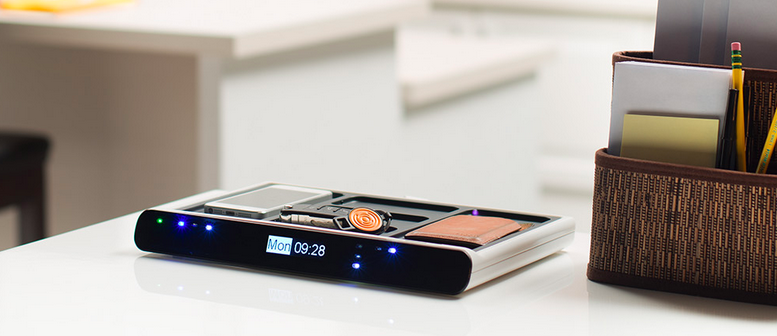
OCHO
The OCHO line of devices keeps people connected without having to call or send a text message to anyone, plus these gadgets deliver reminders so you don’t forget anything when you leave the house.
The OCHO Pad and mini keeps track of OCHO tags. You can assign tags to different items such as your wallet, phones, or keys, and even assign specific tags to specific members of the family. The OCHO Pad and mini connects to your home or office network via WiFi to access OCHO Cloud where everything you need is stored. The devices have NFC and infrared technology which enables it to track tags.
You can program the OCHO Pad to send notifications and alerts based on specific events or actions, such as setting it up to send you a text message when house key tags are placed back onto the pad. The OCHO Pad can also send alerts if your teenagers haven’t arrived home before curfew. You can program this smart pad to send notes when a tag is placed on the device, perhaps a message telling your kids to order pizza because you’ll be home late.
The OCHO app allows users to access OCHO Cloud on the go, as well as edit notes, reminders and settings. The parental features allow kids to leave notes and reminders, but not alter any other settings in the system.
OCHO is not yet available in the market but if you want to be one of the first to get it, you can support the project on Kickstarter.
Cefaly headband
The FDA has recently approved an external device that promises to help manage migraines. The Cefaly headband, which looks like something from the movie Avatar, uses nerve stimulation to to decrease the frequency of debilitating migraine headaches. It connects to a stick-on electrode to stimulate the endings of the trigeminal nerve, the largest of the cranial nerves responsible for sensations in the face, motor functions such as biting, chewing, and swallowing, and is thought to be one of the causing factors in migraine occurrences.
Belgian company STX-Med developed Cefaly, which is already approved for sale in Europe, tallying roughly 50,000 units sold so far. It is the first non-pharmaceutical treatment for chronic migraines approved by the FDA.
For Cefaly to work, a patient who suffers from chronic migraines needs to wear the device for 20 minutes a day. A clinical trial conducted on 67 people showed that those who use Cefaly everyday for the prescribed time experienced fewer headaches in a month. STX-Med claims that Cefaly also relieves pain of a migraine in progress, but the FDA found no evidence of this claim on the clinical trial.
If you suffer from chronic migraine and want to try Cefaly, be warned that test subjects have reported a tingling sensation when the headband is in used.
Eko
Eko Devices, a startup company that specializes in next generation medical devices, launched the Eko, a stethoscope that improves monitoring and detection of heart conditions and combats the soaring cost of cardiac care. Eko does so by providing clinicians with unprecedented heart sound amplification, recording, collaboration, and analysis using existing analog stethoscopes.
The Eko is a system which includes the Core, a device that directly attaches to a stethoscope’s tubing to amplify and transmit high-quality digitized heart sounds through the stethoscope’s earbuds, and digitally streams the sounds to the Eko Software on a smartphone or tablet. The software presents sound waveforms visually for easy analysis. With the use of the mobile app, physicians can record, save, slow down, and playback heart sounds, share sounds with other physicians or specialists for follow-up, and analyze sounds at point of care using heart murmur detection algorithm.
“Heart disease is the No. 1 killer in the United States and there is an enormous need for clinicians to provide excellent yet affordable cardiac care. Eko combines the traditional stethoscope with an innovative technology which promises to improve the care we provide at a very low cost. I’m excited to see how we can use it in the clinic,” said UC San Francisco cardiologist, Dr. John Chorba.
Support our mission to keep content open and free by engaging with theCUBE community. Join theCUBE’s Alumni Trust Network, where technology leaders connect, share intelligence and create opportunities.
Founded by tech visionaries John Furrier and Dave Vellante, SiliconANGLE Media has built a dynamic ecosystem of industry-leading digital media brands that reach 15+ million elite tech professionals. Our new proprietary theCUBE AI Video Cloud is breaking ground in audience interaction, leveraging theCUBEai.com neural network to help technology companies make data-driven decisions and stay at the forefront of industry conversations.




