







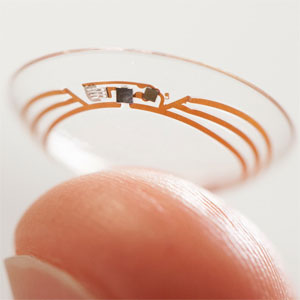
 Google has patented a system in which cameras would be embedded into contact lenses. What would this accomplish? It could help generate pictures of everything that comes into the field of view of the user, and possibly a breakthrough for blind and visually impaired.
It’s been known for some time that Google was working on the development of the contact lens and the technology company had a pending patent for it. Google X Labs recently presented a contact lens developed for diabetics, with sensors for detecting glucose levels from tear production. This would, of course, enable diabetics to skip the annoying finger prick required to take a fast blood test.
This time around, Google has come up with a way to embed small cameras inside the contact lenses. As per an article in Patent Bolt, the tiny camera can be aligned in a way that it helps track and generate data of an image or a scene corresponding to the gaze of the wearer. The images can then be processed in real time in the local or sent to a remote server. The patent indicates that the image data can be processed to detect light, colors, and patterns of colors, faces, motion, or any other type of similar data.
To explain the role of the technology, Google describes a situation in which the contact lens could prove helpful. When approaching an intersection, the two lenses will be able to scan the road and in the event that it detects a vehicle approaching, notify the person with a sound message issued from the smartphone or directly through a headset.
For power, the contact lenses may be capable of generating energy from the movement or by the heat emitted from the wearer’s body. Google further notes that the sensor can be any suitable sensor for capturing energy wirelessly or mechanically. For example, the sensor can be a photodiode, a pressure sensor, a conductivity sensor, a temperature sensor, an electric field sensor, or a micromechanical switch.
Also per Patent Bolt, Google notes an example for users with healthy vision. Google sees the processed image data can be presented on a display integrated into contact lens such as highlighting of the car in motion approaching the crosswalk and provide a warning light emitting diode (LED), a wider peripheral view of the scene or any other suitable presentation of processed image data such as a TV screen or a user interface.
This camera would apparently have the power to replace binoculars, giving people the ability to see farther by focusing in on distant objects more clearly. In this way they could theoretically improve eyesight, not unlike traditional contact lenses.
The documents filed with the USPTO (United States Patent and Trademark Office) makes no reference to implementation of the technology into products for the market in the short term.
[Top photo credit, Google from the Google Official Blog, “Introducing our smart contact lens project“]
Support our mission to keep content open and free by engaging with theCUBE community. Join theCUBE’s Alumni Trust Network, where technology leaders connect, share intelligence and create opportunities.
Founded by tech visionaries John Furrier and Dave Vellante, SiliconANGLE Media has built a dynamic ecosystem of industry-leading digital media brands that reach 15+ million elite tech professionals. Our new proprietary theCUBE AI Video Cloud is breaking ground in audience interaction, leveraging theCUBEai.com neural network to help technology companies make data-driven decisions and stay at the forefront of industry conversations.




