







 Today’s IT teams need powerful solutions for providing tools and support across both office and data center. To assist them, EMC has been working on a multitude of fronts on virtualization and building the infrastructure foundation of the software-defined data center. EMC hopes to shine as a provider of software-defined architecture, cloud solutions, and IT-as-a-service.
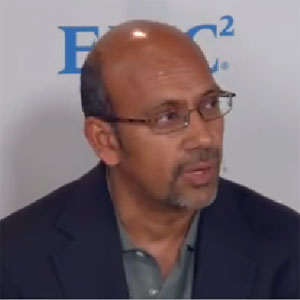
As EMC’s VP and Chief IT Architect, Dr. Narayanan Krishnakumar leads the IT Office of Architecture and Innovation and is responsible for overall enterprise architecture and strategy.
To get a better picture of EMC’s role across enterprise infrastructure, theCUBE’s Dave Vellante and Jeff Frick spoke with Krishnakumar at the recent EMC World 2014 conference in Las Vegas.
According to Krishnakumar, his role is to define and innovate on architectural front. EMC is devoting time on application development, security, infrastructure and others but there was originally no coloration between any of these teams. His team partnered with other EMC IT teams to define the enterprise architecture, adopt technical standards, evaluate new technologies, incubate innovative ideas, and develop business and technology roadmaps for EMC’s IT solutions.
Krishnakumar continued that his team started the “virtual first approach”, where they started to move business critical applications, client facing applications like Powerlink, existing applications and other applications to virtual platform. His IT team started their internal efforts to consolidate platforms, master data management, standardized reporting and the like. The team has been working towards enabling virtualization across our entire organization and business model.
He then started looking at business agility, automation and mobility and overall IT-as-a-Service. Currently the team is working of making applications cloud aware, and increase mobility. The reason he gave was we all carry powerful easy-to-use mobile devices, and we all prefer easy-to-consume application experiences to go with them. Desktops and laptops are receiving less use; while tablets and smartphones have quickly become our first go-to devices.
When asked about the company’s enterprise file management system, Krishnakumar said that Syncplicity is the foremost tool from EMC that provides native cloud-based sync and file share capabilities, enabling organizations to manage, sync, share and backup files across its extended enterprise. As cloud, social and mobile dominate the way work gets done, users require more than simple containers for managing and sharing content.
With Syncplicity, EMC is delivering a best-in-class solutions for true extended enterprise collaboration.
“Many of the EMC services especially in the context of IT-as-a-Service is all about preserving the integrity, availability, and EMC is enabling different solutions through Syncplicity as how business can change the way they work,” he added.
To afford mobile business users, Krishnakumar also said, the Syncplicity Connector for SharePoint, which allows business users to view and edit their files using the SharePoint Syncplicity app on their mobile devices. On the security side, Syncplicity has also been enriched with the function StorageVault Authentication to better protect the shared files.
EMC’s strategy for software-defined data centers is enabling control layers to be abstracted from the underlying infrastructure, allowing for pooling of processing cores, network resources, and storage. EMC has also launched a series of software-defined storage technologies and courted the hybrid data center cloud with everything from appliances to software.
The innovations that EMC has developed for the hybrid cloud are designed to offer customers and service providers not only the level of control and security of a private cloud, but also the ease of use, agility and the efficiency needed to continue to redefine the IT.
Krishnakumar added that Syncplicity makes it possible to set up file management capabilities to mobile users without having the data itself moved out of enterprise control.
Support our mission to keep content open and free by engaging with theCUBE community. Join theCUBE’s Alumni Trust Network, where technology leaders connect, share intelligence and create opportunities.
Founded by tech visionaries John Furrier and Dave Vellante, SiliconANGLE Media has built a dynamic ecosystem of industry-leading digital media brands that reach 15+ million elite tech professionals. Our new proprietary theCUBE AI Video Cloud is breaking ground in audience interaction, leveraging theCUBEai.com neural network to help technology companies make data-driven decisions and stay at the forefront of industry conversations.




