Companies and service providers designing cloud services to control costs should aim at the “fat middle” of the application population, with a goal of reducing storage costs 50 percent for 80 percent of applications, writes Wikibon CTO David Floyer in “The Challenges of Enabling Low-cost Enterprise Cloud Storage Services”. The “fat middle” is made up Tier 1-light and Tier 2 applications, and the design focus should be on simplicity in architecture and management. The service specifically should not be designed for very low latency databases and applications that demand more expensive services and management on the one side or applications that need very low cost storage on the other.
Today hybrid arrays provide the best compromise between performance and cost, Floyer writes. All-flash arrays are still too expensive and focused on high-performance applications where cost-per-IOPS is more important than cost-per-Gbyte. Server SAN, which combines the advantages of software-defined storage and direct-attached storage to provide a flexible, high-performance storage architecture, is still too immature although Floyer believes this situation will change rapidly in 2015 and beyond.
Many vendors provide hybrid systems that can work, but he focuses on IBM’s XIV. It provides simplicity, eliminates the need for tiering for the target applications, handles “noisy neighbors” (applications that make heavy demands on infrastructure that may impact other applications sharing the same storage array) and can be operated by a small staff. He recommends that XIV be included in RFPs for shared storage services, although it is not perfect, and he provides a detailed analysis of its strengths and weaknesses.
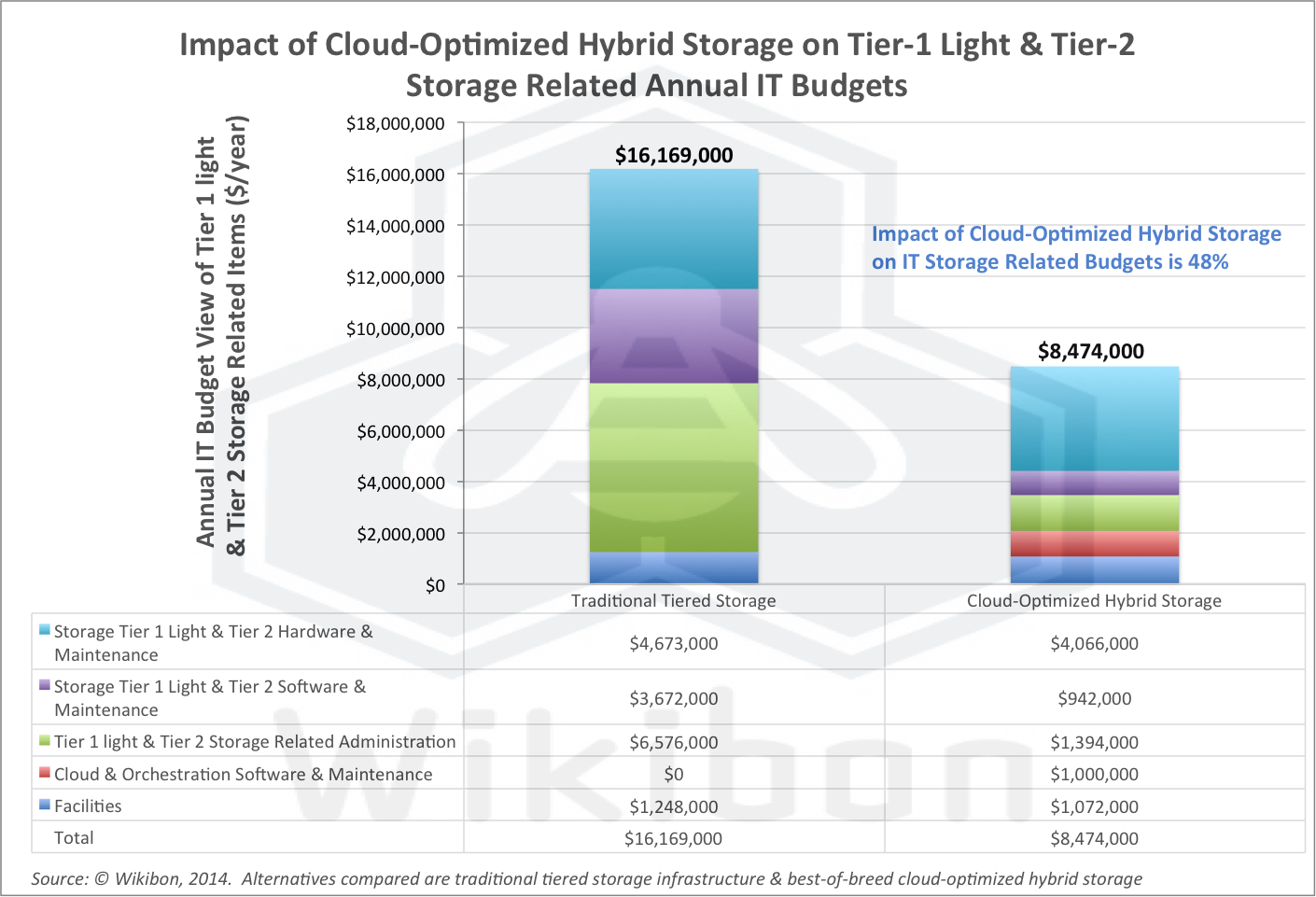
Floyer presents a model comparing the cost of traditional tiered storage to that of cloud-optimized hybrid storage for a company with $10 billion in revenue and a total IT budget of $150 million (see graphic above). The model predicts that for the “fat middle” applications, the total cost of storage could be reduced from $16,169,000 to $8,474,000.
As with all Wikibon research, this Professional Alert is available in its entirety without charge on the Wikibon Web site. IT professionals are invited to register for free membership in the Wikibon community, which allows them to participate in Wikibon research, influence the research agenda, and publish their own research, questions and comments.
Support our mission to keep content open and free by engaging with theCUBE community. Join theCUBE’s Alumni Trust Network, where technology leaders connect, share intelligence and create opportunities.
Founded by tech visionaries John Furrier and Dave Vellante, SiliconANGLE Media has built a dynamic ecosystem of industry-leading digital media brands that reach 15+ million elite tech professionals. Our new proprietary theCUBE AI Video Cloud is breaking ground in audience interaction, leveraging theCUBEai.com neural network to help technology companies make data-driven decisions and stay at the forefront of industry conversations.