







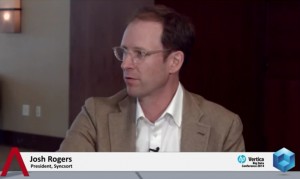
In the world of Big Data, companies such as Syncsort Inc. look to the developer community and cloud integration opportunities to spark innovation around open-source software like Hadoop. Crafting data storage solutions for clients and working with analytic database management software companies like Hewlett-Packard Co.’s Vertica Systems, Syncsort president Josh Rogers shared the role of developers behind some of its recent successes, the challenges his teams have overcome, and how economics play a role in addressing those challenges.
Here is a recap of Rogers’s recent discussion with John Furrier and Jeff Kelly of theCUBE at last week’s HP Vertica Big Data Conference (BDC) 2014.
When asked about any upcoming Syncsort products, Rogers revealed that at the end of Q2 the company updated its load mechanism, one of the fastest, for use with Vertica. The mechanism uses an intelligent connector to help clients move data more easily between various environments within the Vertica system.
Syncsort has also developed solutions that utilize a variety of systems. And, according to Rogers, “Our strategy is to make our software available for how they like to consume it. So … in November of last year, we launched the Hadoop offering in the cloud. In May of this year, we offered the ETL version, directly on EC2. What we found is this huge uptake by the development community to build integrations in the cloud. Some of those get run in the cloud; some of those get run on premise.”
Some roadblocks still exist. Part of the problem is that some companies still rely on older technologies to both manage and protect their data, with the eventual aim to switch over to the cloud. According to Rogers, eventually more and more data will move to the public cloud.
“I think it boils down to economics to get the level of flexibility to be able to scale up and scale down workloads,” he pointed out. “The amount of researching you have to build in and on premise fashion just becomes economically unfeasible. So, at the end of the day, I think it’s economics, but there is certainly a level of agility that people get that causes them to pursue that strategy.”
See Rogers’ entire segment below:
Support our mission to keep content open and free by engaging with theCUBE community. Join theCUBE’s Alumni Trust Network, where technology leaders connect, share intelligence and create opportunities.
Founded by tech visionaries John Furrier and Dave Vellante, SiliconANGLE Media has built a dynamic ecosystem of industry-leading digital media brands that reach 15+ million elite tech professionals. Our new proprietary theCUBE AI Video Cloud is breaking ground in audience interaction, leveraging theCUBEai.com neural network to help technology companies make data-driven decisions and stay at the forefront of industry conversations.




