







 “Amazon has turned the data center into an API,” writes Wikibon CEO David Vellante in his latest Professional Alert. This, along with Amazon’s aggressive pricing, rapid pace of innovation and willingness to forego profits indefinitely while investing proceeds back into capital expenditures, is revolutionizing IT for both big systems vendors and IT practitioners.
In particular, Vellante notes, the economics of infrastructure outsourcing, which formerly had negative economies of scale at volume, are starting to track software marginal economics, with incremental costs going to zero. To compete with these cost structures, IT organizations and cloud vendors will need either massive scale or very tight vertical integration.
Vellante cites a recent interview on theCUBE with Alan Nance, VP of technology for Royal Philips, at the HP Vertica conference in August as one indicator of the impact of the Amazon economy. Nance said that Philips has rebuilt its once fragmented infrastructure around seven cloud-based services. It now makes all IT purchases on a consumption basis with no up-front fees, setup fees, enterprise licensing agreements (ELAs) or penalties for turning off services. It pays vendors only for what it consumes in its internal cloud, just as it would if it were running on a public cloud. And this, Vellante writes, is not unique to Philips.
Amazon’s introduction of its EC2 cloud service in 2006 kicked off a major shift in the IT market toward a utility or consumption model. One of their main attractions of cloud services is the flexibility that “pay by the drink” provides to manage through unexpected expansion or contraction of computing needs. Companies are also coming to the conclusion that IT infrastructure doesn’t provide much competitive differentiation.
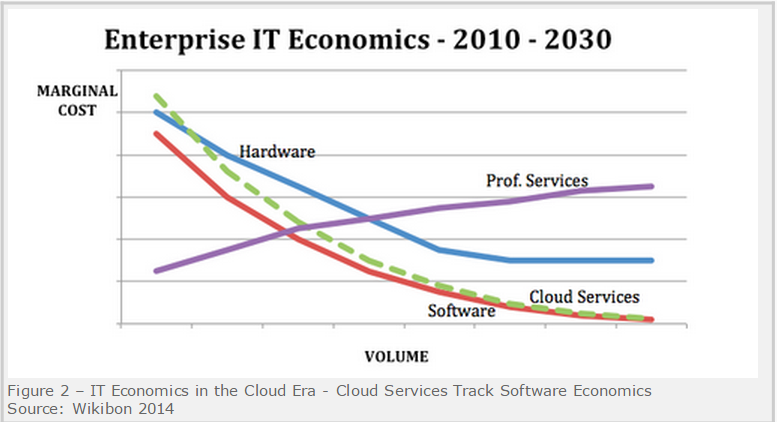 Vellante projects that as cloud services grow in scale over the next 20 years they will overwhelm the ability of most IT organizations to stay competitive on a price basis. This, he says, is why Amazon is investing so heavily in AWS infrastructure as well as retail warehouses. To remain competitive, other vendors must either scale aggressively – like Google, Microsoft and Facebook are doing – or develop highly integrated and massive stacks, which is the approach being taken by Oracle and IBM.
The same dynamic applies to internal IT organizations. CIOs, he says, should only expend labor for managing IT infrastructure when it drives corporate profit. Otherwise they should focus on integration and adding differential value through analytics, new services, and innovative digital business models.
Vellante’s full report is available without charge on the Wikibon Web site. Interested IT professionals are invited to register for free membership in the Wikibon community, which allows them to influence the direction of Wikibon research and participate in that research as well as post comments, questions and their own research.
Support our mission to keep content open and free by engaging with theCUBE community. Join theCUBE’s Alumni Trust Network, where technology leaders connect, share intelligence and create opportunities.
Founded by tech visionaries John Furrier and Dave Vellante, SiliconANGLE Media has built a dynamic ecosystem of industry-leading digital media brands that reach 15+ million elite tech professionals. Our new proprietary theCUBE AI Video Cloud is breaking ground in audience interaction, leveraging theCUBEai.com neural network to help technology companies make data-driven decisions and stay at the forefront of industry conversations.




