






Using video games as an educational tool is not a new concept, and edutainment titles have been around since at least the days of Oregon Trail and Where in the World is Carmen Sandiego? Lately, educational games have been moving into the mobile space much like everything else, but a recent study by researchers at Carnegie Mellon University shows that mixing games with real world interaction is substantially more effective than touchscreen games alone.
“As screen-based technologies such as tablets or computer games become increasingly more appealing for children, it is worth asking whether real-world interaction is really needed to enhance learning and enjoyment,” researcher Nesra Yannier said in a video abstract for the study.
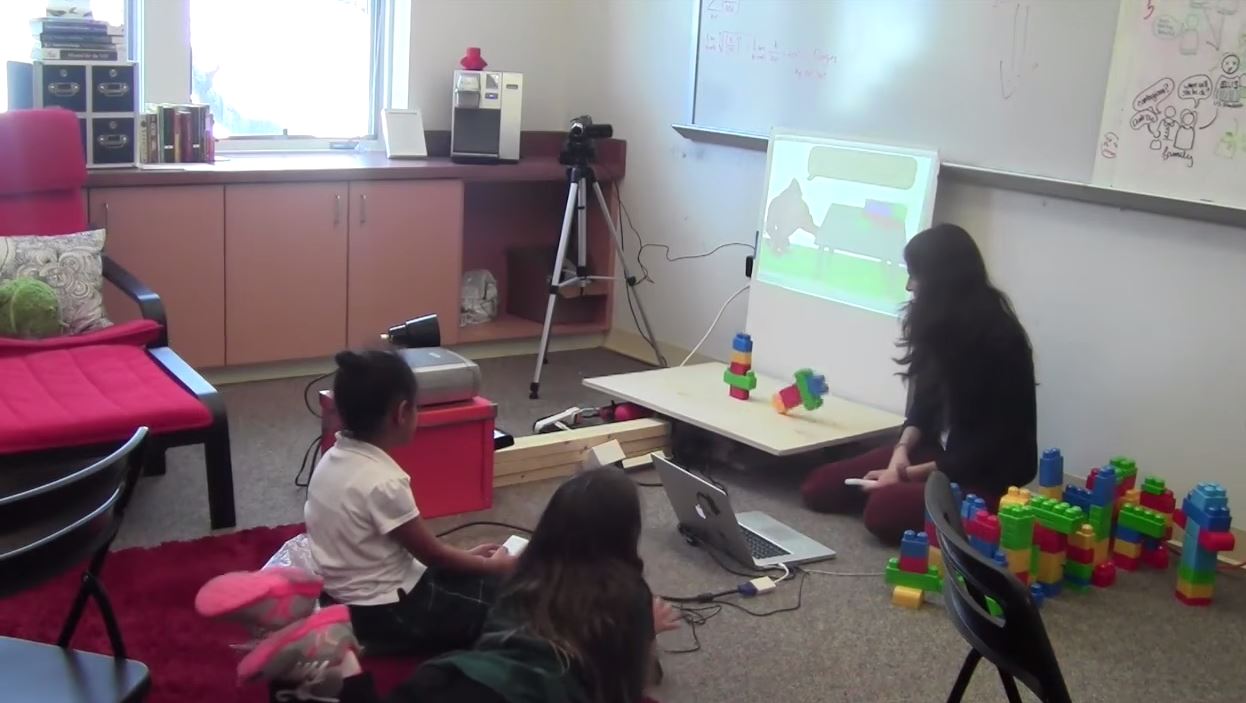
The experiment used multiple versions of a simple game that instructed children to build a block tower that could withstand being shaken.
Children played the game on a laptop and tablet, and their results were then compared to other children who played versions that used real blocks combined with a Kinect and a projected screen. The Kinect monitored the children’s progress and gave them feedback when their tower stood or collapsed.
The results showed that the children who played the Kinect version learned the lesson at a much higher rate than those who played the laptop or tablet versions.
“Utilizing computer vision to provide personalized immediate feedback while children experiment in their physical environment may be a powerful way to learn,” Yannier said. “Our study demonstrates that physical observation accompanied by interactive feedback in our mixed-reality game improves children’s learning by approximately five times compared to an equivalent tablet or computer game while also increasing enjoyment.”
The study noted that simply including physical controls is not enough to improve the educational effect. While the tablet version allowed children to shake the device to see if their tower would fall, the researchers found that this feature did not significantly improve that version’s success rate.
“Our 2×2 experiment found no evidence that adding simple forms of hands-on control enhances learning, while demonstrating a large impact of physical observation,” the study concluded. “A general implication for educational game design is that affording physical observation in the real world accompanied by interactive feedback may be more important than affording simple hands-on control on a tablet.”
Support our mission to keep content open and free by engaging with theCUBE community. Join theCUBE’s Alumni Trust Network, where technology leaders connect, share intelligence and create opportunities.
Founded by tech visionaries John Furrier and Dave Vellante, SiliconANGLE Media has built a dynamic ecosystem of industry-leading digital media brands that reach 15+ million elite tech professionals. Our new proprietary theCUBE AI Video Cloud is breaking ground in audience interaction, leveraging theCUBEai.com neural network to help technology companies make data-driven decisions and stay at the forefront of industry conversations.





