 WIKIBON
WIKIBON
WIKIBON






WIKIBON

A major advantage driving the trend to all-flash storage environments is the prospect of replacing most database copies with snapshots, in the process cutting total storage needs in half. However, the danger is out-of-control snapshot proliferation that quickly grows beyond the ability of manual methods to manage adequately. The answer, writes Wikibon CTO David Floyer, is automated cataloging and policy management that tracks all snapshots through their lifecycles.
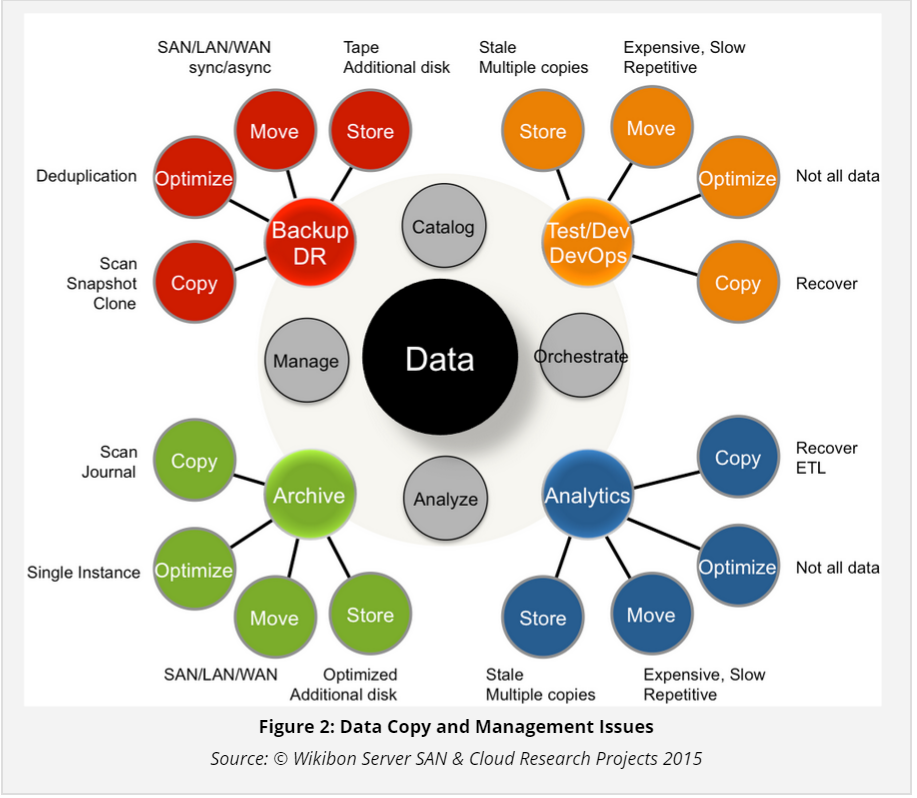
Flash, with its orders-of-magnitude advantages in I/O speed and density, is clearly the future for active data. It improves application performance and end-user productivity and cuts operating expenses (OPEX). In this future scenario, snapshots create logical copies of production databases, replacing the time-consuming and expensive process of making eight-to-10 physical copies (on average) to support various needs in backup, archive, test/dev and analytics (see graphic above). In the all-flash environment only three to four copies are needed, including on-site and off-site backup. All other needs are served through logical copies of the database.
The benefits include snapshots be made in seconds, versus hours or days to make a physical copy of the database. Snapshots can also be moved across the network instantly and they take up a fraction of the space. Snapshots in an all-flash data center revolutionize workflow, saving huge amounts of valuable staff time, keeping production databases available 24X7 and freeing resources for move valuable tasks.
The value of the full set of benefits can make flash the less expensive choice in total lifetime cost today. Not everyone is ready to realize this fact, however. Floyer writes. For one thing, it goes against every instinct of current storage and operational practice, where multiple copies are seen as good, and flash is used only as a cache in front of each data copy.
Also, automated snapshot cataloging is an absolute necessity. Snapshots are too easy to make to allow manual tracking on a spreadsheet. Without automation, confusion will quickly ensue: Which snapshot is most recent? If data is archived or deleted, which snapshots will be lost? Which is most appropriate for the needs of the moment? The problem is that cataloging software is not yet fully functional and available across all storage platforms.
Floyer recommends that CIOs create an optimized all-flash virtual environment with automated cataloging run by a team of the ITO’s best and brightest as a demo environment to sell the benefits to the business and IT.
Support our mission to keep content open and free by engaging with theCUBE community. Join theCUBE’s Alumni Trust Network, where technology leaders connect, share intelligence and create opportunities.
Founded by tech visionaries John Furrier and Dave Vellante, SiliconANGLE Media has built a dynamic ecosystem of industry-leading digital media brands that reach 15+ million elite tech professionals. Our new proprietary theCUBE AI Video Cloud is breaking ground in audience interaction, leveraging theCUBEai.com neural network to help technology companies make data-driven decisions and stay at the forefront of industry conversations.





