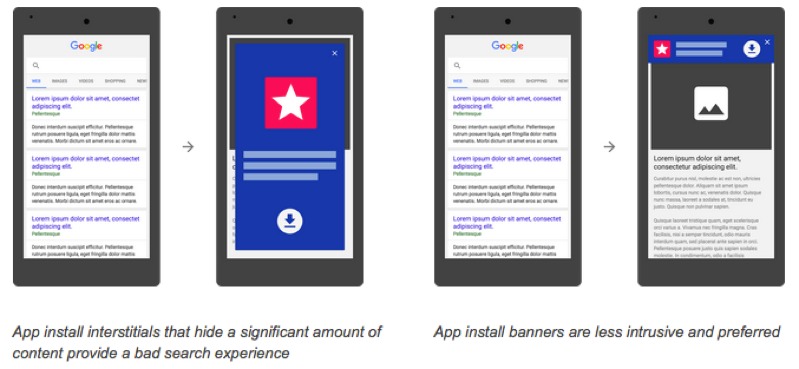







In a move likely to be rejoiced by anyone who has ever used their smartphone to access a website, Google has announced that it’s cracking down on companies who use full-screen overlay app install interstitial ads on their sites.
The move will see Google kick sites who use this form of advertising where it hurts by penalizing those sites in Google’s search results; the sites aren’t being removed from Google but instead moving further down in the results, a move that could be a traffic killer for sites that either are featured in the first page of Google search results, or even as the first or second search result.
“After November 1, mobile web pages that show an app install interstitial that hides a significant amount of content on the transition from the search result page will no longer be considered mobile-friendly,” Google Search Software Engineer Daniel Bathgate writes on the Google Webmaster Central blog.
The move comes through a change to Google’s the Mobile-Friendly Test that now indicates that sites should avoid showing app install interstitials “that hide a significant amount of content on the transition from the search result page.”
While on one hand encouraging sites to use app install banners instead, Google sadly adds that this move does not affect other types of interstitials, so that while the move will hopefully see a reduction in sites with annoying, unwanted, hard to close interstitials, it still allows the same format without penalty where that interstitial isn’t pushing an app install.
While a start, the move by Google to penalize people pushing app installs by overlay interstitials doesn’t go nearly far enough.
In stating what anyone with half a brain could have told them, Bathgate notes of full-page interstitials in his post that “our analysis shows that it is not a good search experience and can be frustrating for users because they are expecting to see the content of the web page…”
It’s hard not to laugh because it’s so blatantly obvious, but it then begs the question: why only crack down on those using the format to push app installs and not every site who uses them?
Is it perhaps because Google ads sometimes appear in other types of interstitals?
Whatever the reason is it will be interesting to see exactly how Google applies the new move given they’re one of the worst offenders themselves when it comes to app install interstitials, as Mike Dudas (via TechCrunch) succinctly highlights in the follow tweet.
https://twitter.com/mdudas/status/638792939842469893?ref_src=twsrc^tfw
Support our mission to keep content open and free by engaging with theCUBE community. Join theCUBE’s Alumni Trust Network, where technology leaders connect, share intelligence and create opportunities.
Founded by tech visionaries John Furrier and Dave Vellante, SiliconANGLE Media has built a dynamic ecosystem of industry-leading digital media brands that reach 15+ million elite tech professionals. Our new proprietary theCUBE AI Video Cloud is breaking ground in audience interaction, leveraging theCUBEai.com neural network to help technology companies make data-driven decisions and stay at the forefront of industry conversations.





