 WIKIBON
WIKIBON
WIKIBON






WIKIBON

The DevOps world is getting a little more crowded this morning with the release of two additional automation tools from HashiCorp Inc., one of which is a successor to its hugely-popular Vagrant deployment automation tool that promises to drastically simplify code rollouts. It’s the same pitch that helped propel containers to developer stardom.
But whereas the latter technology achieves the interoperability needed to move an application from a test environment to production by encapsulating its components in a lightweight portable instance, Vagrant simplify copies the deployment settings across the two locations. The underlying virtualization paradigm can be anything from a container to a conventional virtual machine.
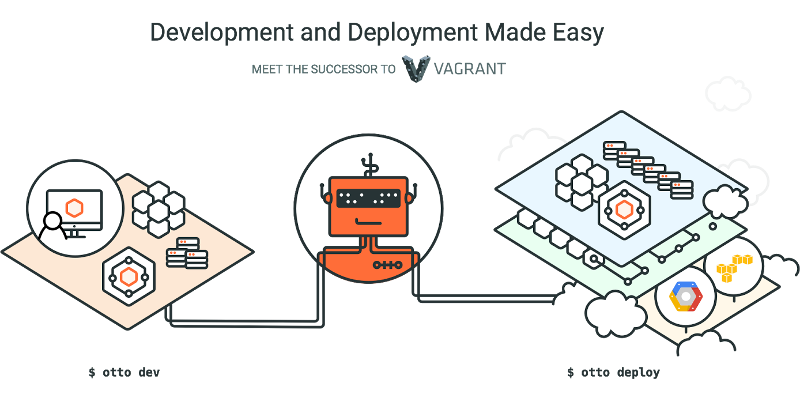
Otto, the newly debuted Vagrant successor, extends that functionality to more advanced applications that are spread out over multiple environments, a use case that is becoming increasingly common as more organizations jump aboard the hybrid cloud bandwagon. The tool also enables users to propagate their settings to HashiCorp’s six other open-source configuration tools.
The lineup is designed to automate the various chores involved in running production instances that use Vagrant, including most of everything from copying images to putting together and setting up distributed clusters across different types of infrastructure. The sixth and newest item on the list, Nomad, is launching in conjunction with Otto to add scheduling capabilities to the mix.
The tool consists of a single file that is deployed on a master server to act as the nervecenter for the other nodes in a cluster, each of which runs an agent that communicates how much capacity its particular box can spare. Nomad uses that information to quickly distribute work without wasting time checking the availability of each machine when a new task is received.
That functionality works equally well with containers and virtual machines, as well as environments that use a combination thereof, thanks to the fact that the tool borrows a page from Otto and uses the same high-level configuration specification for both. That consistently doubles to help Nomad scale across data centers with the same efficiency, an essential feature for large-scale cloud deployments nowadays.
That addition should make the technology more appealing to the enterprises that HashiCorp hopes is targeting with its commercial offering, Atlas, which combines its open-source tools into a single toolchain and layers a set of productivity features on top. Nomad itself, however, is completely free along along with all the other components of the platform.
Support our mission to keep content open and free by engaging with theCUBE community. Join theCUBE’s Alumni Trust Network, where technology leaders connect, share intelligence and create opportunities.
Founded by tech visionaries John Furrier and Dave Vellante, SiliconANGLE Media has built a dynamic ecosystem of industry-leading digital media brands that reach 15+ million elite tech professionals. Our new proprietary theCUBE AI Video Cloud is breaking ground in audience interaction, leveraging theCUBEai.com neural network to help technology companies make data-driven decisions and stay at the forefront of industry conversations.





