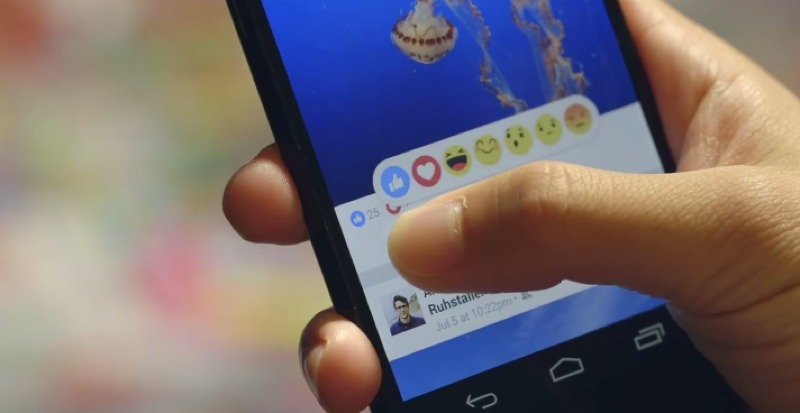







Despite the fact most of the media predicted that Facebook, Inc. was planning to launch a dislike button, the social networking goliath has instead started testing “Reactions,” an extension of the Facebook like button that allows (as the name may suggest) users to express a reaction about a post on Facebook.
The new service, to be tested first in Spain and Ireland, allows users to select one of six emoji (in addition to the standard like) that is said to allow users quickly respond with love, laughter, happiness, shock, sadness and anger.
Facebook’s Mark Zuckerberg explained the move, describing how move was about providing better options for user expression while keeping the experience simple and respectful, ie: not a dislike button that would work essentially as a proxy down-voting button.
“Reactions gives you new ways to express love, awe, humor and sadness,” Zuckerberg said. “It’s not a dislike button, but it does give you the power to easily express sorrow and empathy — in addition to delight and warmth.”
“You’ll be able to express these reactions by long pressing or hovering over the Like button.”
Options available, at least in the trial, include emoji labeled love, “haha,” yay, wow, sad and angry, complete naturally with emoji’s expressing those words.
Explaining the path of the test, Facebook’s Chief of Product Chris Cox also explained why it wasn’t a dislike button, saying “We studied which comments and reactions are most commonly and universally expressed across Facebook, then worked to design an experience around them that was elegant and fun.”
Putting aside that it’s not clear why Facebook is starting the test in Ireland and Spain (usually it’s iOS users to the exclusion of Android users), the move to extend the like button to “reactions” is a positive step forward for Facebook.
It doesn’t always happen, but many Facebook users would have experienced times where they wanted to support someone on Facebook but at the same time expressing “like” to it was inappropriate, one example being someone with cancer undergoing chemotherapy; yes, you want the treatment to be successful but it’s hardly appropriate to like the fact they’re undergoing chemo versus wishing to express support that the treatment is successful.
There’s no word on when the reaction test will be rolled out to other Facebook users or even if it ever will given it is literally a test to see how users like it, but here’s hoping the test is successful and these options will be available globally to users soon.
Support our mission to keep content open and free by engaging with theCUBE community. Join theCUBE’s Alumni Trust Network, where technology leaders connect, share intelligence and create opportunities.
Founded by tech visionaries John Furrier and Dave Vellante, SiliconANGLE Media has built a dynamic ecosystem of industry-leading digital media brands that reach 15+ million elite tech professionals. Our new proprietary theCUBE AI Video Cloud is breaking ground in audience interaction, leveraging theCUBEai.com neural network to help technology companies make data-driven decisions and stay at the forefront of industry conversations.





