 WIKIBON
WIKIBON
WIKIBON






WIKIBON

The next generation of applications, which Wikibon calls “Systems of Intelligence,” will create major changes not just in computing but in business processes and capabilities. These new applications do not replace traditional systems of record; ERP, CRM and corporate financial systems will still be with us for the foreseeable future. Rather, they will combine the data from those systems with data from other sources, both inside and outside the organization, and apply predictive analytics to anticipate and shape the immediate future.
Applied to customer service, for instance, they will make instant decisions based on data to anticipate the customer’s needs and offer the best fit product or service at the most appropriate price without human intervention. Instead of steering the ship by looking at its wake, they will part the fog ahead to locate the most likely locations of the icebergs and plot the best course for the enterprise.
Everything, however, has costs and tradeoffs. When literacy grew in ancient Greece, Socrates predicted that it would create people with poor memories. Smart phones are incredibly useful, but they also create vulnerabilities that can destroy our privacy. So it is no surprise that Systems of Intelligence come with tradeoffs – not all of them financial – that companies need to plan for. In his latest Wikibon.com Alert, “Budgeting for Trade-Offs in Systems of Intelligence”, Wikibon Big Data Analyst George Gilbert argues that Systems of Intelligence will create the biggest change in enterprise applications in 50 years, and that will demand major changes in the way IT is used.
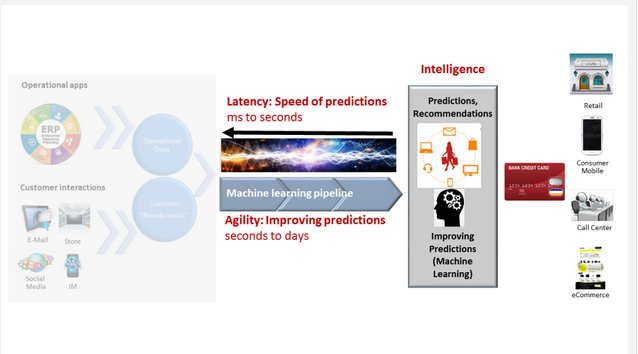
Systems of Record are built on data “pipelines” that operate in batch mode. The emphasis is on keeping the data safe for the long term and on creating a single version of truth. Systems of Intelligence require microsecond data streams and operate on the date in real time as it streams past. Opportunities are fleeting. Serving ads on social media, for instance, requires that the right ad be put in front of the right consumer at the right instant. A minute or two later the consumer has made the purchase, and the ad is valueless.
The pipelines for systems of record are difficult to change. If business users need some new measurement added to a report, the entire process, from creating the data pipeline to generating the report, has to be redesigned. In contrast, Systems of Intelligence pipelines are driven by continuous machine learning and need for flexibility. They need to adapt relevant new data sources and types as they become available without skipping a beat.
Gilbert identifies six variables or “knobs” that users can turn to optimize a System of Intelligence. The first three – accuracy of predictions, speed of predictions and speed of improving predictions – are closely interrelated. If you require highly accurate predictions, the speed of delivering them probably will decrease. If speed of predictions is most important, you have to accept a higher incidence of errors. The last three – total cost of ownership/operational complexity, development complexity and existing infrastructure technology and skills – are related in a different way. Developing and operating highly complex systems can provide strategic benefits to companies, but they are only possible if the company has a staff that can design, create and operate a highly complex system. A Netflix-level predictive System of Intelligence is beyond the capabilities of most IT organizations, Gilbert writes.
Gilbert maps the corporate journey into Systems of Intelligence and says that the technical leaders responsible for implementing these systems need to explicitly define and explain the trade-offs to the business. Setting expectations is important; non-technical business staff may not understand why they cannot have everything, and if they expect more than the IT can deliver, problems will ensue.
Support our mission to keep content open and free by engaging with theCUBE community. Join theCUBE’s Alumni Trust Network, where technology leaders connect, share intelligence and create opportunities.
Founded by tech visionaries John Furrier and Dave Vellante, SiliconANGLE Media has built a dynamic ecosystem of industry-leading digital media brands that reach 15+ million elite tech professionals. Our new proprietary theCUBE AI Video Cloud is breaking ground in audience interaction, leveraging theCUBEai.com neural network to help technology companies make data-driven decisions and stay at the forefront of industry conversations.





