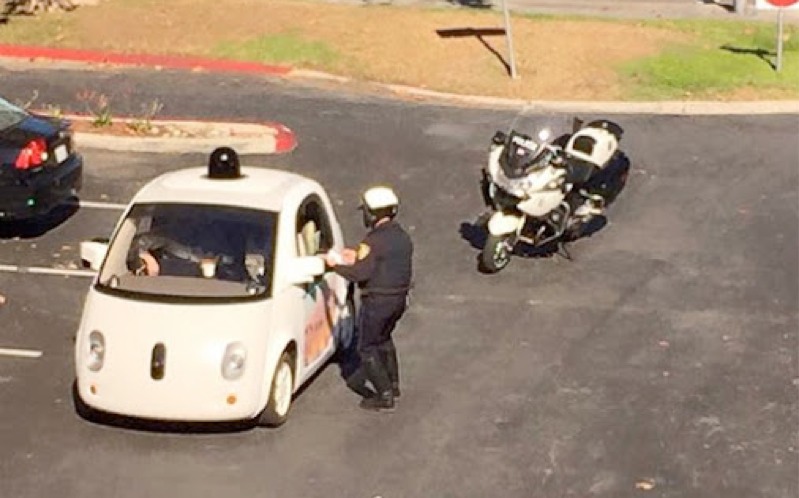







One of Google’s cute, little self-driving cars had a run-in with the law Thursday, with a test vehicle being pulled over by an Officer in Mountain View.
While the notion of a self-driving car being pulled over for a traffic infringement it both amusing and ethically interesting at the same time, the vehicle was actually pulled over due to it doing 24 miles per hour in a 35 miles per hour speed zone.
“Driving too slowly? Bet humans don’t get pulled over for that too often,” the Google Self-Driving Car team said in a Google+ post about the incident. “We’ve capped the speed of our prototype vehicles at 25 mph for safety reasons.”
As it turns out, driving below the speed limit on a suburban road isn’t a traffic offense in California, leading the team to give this (rather odd) explanation: “Like this officer, people sometimes flag us down when they want to know more about our project. After 1.2 million miles of autonomous driving (that’s the human equivalent of 90 years of driving experience), we’re proud to say we’ve never been ticketed!”
For its part, the Mountain View Police Department explained what occurred, writing that the incident was due to the Google car causing traffic congestion:
This afternoon a Mountain View Police Department traffic officer noticed traffic backing up behind a slow-moving car traveling in the eastbound #3 lane on El Camino Real, near Rengstorff Ave. The car was traveling at 24 mph in a 35 mph zone. As the officer approached the slow moving car he realized it was a Google Autonomous Vehicle. The officer stopped the car and made contact with the operators to learn more about how the car was choosing speeds along certain roadways and to educate the operators about impeding traffic per 22400(a) of the California Vehicle Code. The Google self-driving cars operate under the Neighborhood Electric Vehicle Definition per 385.5 of the California Vehicle Code and can only be operated on roadways with speed limits at or under 35 mph. In this case, it was lawful for the car to be traveling on the street as El Camino Real is rated at 35 mph.
While Google claims that so far none of their self-driving cars have been ticketed for a traffic violation, incidences like this raise again the question of who receives the ticket in the event that it does occur: the car itself or the person sitting in the driver’s position who wasn’t actually driving the vehicle at the time.
According to Re/Code California law currently says a ticket belongs to the person in the driver’s seat, and the DMV is trying to decide what should happen if that seat is empty; for the moment Google has said that if one of its cars breaks the law it will cover the ticket, but that would only work in jurisdictions which only had a monetary fine for an infringement, and not a demerits/ points penalty system in pay as well.
If you are interested in the topic DMV.com has an good read about it here.
Support our mission to keep content open and free by engaging with theCUBE community. Join theCUBE’s Alumni Trust Network, where technology leaders connect, share intelligence and create opportunities.
Founded by tech visionaries John Furrier and Dave Vellante, SiliconANGLE Media has built a dynamic ecosystem of industry-leading digital media brands that reach 15+ million elite tech professionals. Our new proprietary theCUBE AI Video Cloud is breaking ground in audience interaction, leveraging theCUBEai.com neural network to help technology companies make data-driven decisions and stay at the forefront of industry conversations.





