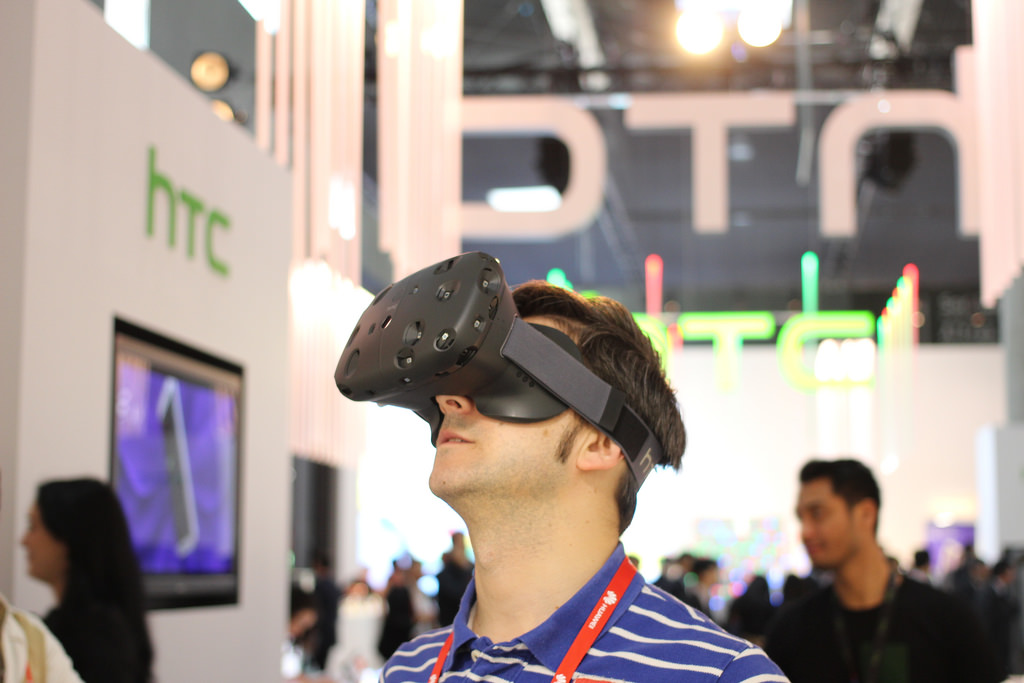







Whether it was an unexpected turn of events or a planned marketing ploy, HTC has revealed that it made the decision to postpone the launch of the Vive virtual reality headset it has been developing with Valve Corp due to “a very, very big technological breakthrough.”
Vive was originally slated for release by the end of the year, but HTC announced earlier this month via social media that it would be pushing back the release to April 2016. Now it seems that the reason for that delay, according to HTC anyway, is that the designers made a major breakthrough, so the company decided to skip the release of the first model and go straight into the updated model at a later date instead.
“We shouldn’t make our users swap their systems later just so we could meet the December shipping date,” HTC CEO Cher Wang told developers at a Vive event in Beijing last week (via Engadget).
Wang would not share exactly what the breakthrough was, but she promised that it would be revealed next month at the Consumer Electronics Show (CES) in Las Vegas.
Much was made of the fact that Vive would be the first high-end virtual reality headset to hit the market, beating out similar systems like Oculus Rift or PlayStation VR. The recent delay places Vive’s release more closely in line with Oculus Rift, which is slated for a Q1 2016 release.
While virtual reality certainly seems to be the “it” topic for 2016, the viability of the product remains in question. Will VR devices sell outside of niche markets like hardcore gaming? Will the technology live up to consumer expectations? Will there be enough VR applications to sustain an (almost) entirely new consumer industry?
Until devices like Vive and Oculus Rift actually hit the market, these questions will continue to keep VR investors anxious about the medium. Even VR developers, such as Oculus VR CTO John Carmack are nervous about where the industry will go.
Earlier this year, at the Game Developers Conference (GDC), Carmack voiced his concern that if a terrible VR device made it to the market first, it could end up “poisoning the well” for the entire industry, much as the failed VR experiments of the 1990s did. He explained that a failed device could scare away potential VR investors, which he called one of the “nightmare scenarios that keep CEOs awake at night.”
Support our mission to keep content open and free by engaging with theCUBE community. Join theCUBE’s Alumni Trust Network, where technology leaders connect, share intelligence and create opportunities.
Founded by tech visionaries John Furrier and Dave Vellante, SiliconANGLE Media has built a dynamic ecosystem of industry-leading digital media brands that reach 15+ million elite tech professionals. Our new proprietary theCUBE AI Video Cloud is breaking ground in audience interaction, leveraging theCUBEai.com neural network to help technology companies make data-driven decisions and stay at the forefront of industry conversations.





