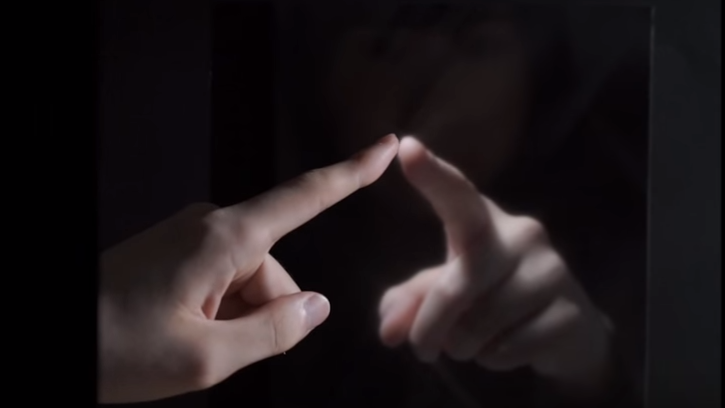







Researchers and engineers at University of Tokyo’s Department of Complexity Science and Engineering have produced a prototype that uses holographic imaging and touch feedback to produce “touchable” holograms. The system is called Haptoclone and allows people to interact over a distance by sending 3D images and touch (or haptic feedback) over a distance to the extent that with a pair of devices two people can “touch” one another across a network.
BCNSTAR reports that the University of Tokyo goal for the project, according to Professor Hiroyuki Shinoda, is to ““continue clarifying the function of haptic sensations to enhance and enrich human communications.”
As a demonstration, two people can reach into paired Haptoclone devices and see one another’s hands reaching for them and “feel” the other hand touch theirs gently.
The holographic technology works with mirrors placed at a 45 degree angle and a projector to create the illusion of depth. The haptic technology uses phased ultrasound to produce points of high air pressure which would provide a gentle resistance. The system is not capable of strong resistance, only a gentle air-touch, which means that one person could place their face in the Haptoclone and the other could gentle stroke them with a hand. However, it would not be possible to simulate a handshake or a slap as this would take extremely strong resistance only possible with powerful ultrasound (which can cause injury or damage to nerves).
Details on the Haptoclone system are available on the Shinoda-Makino Lab webpage as the “Midair Haptic-Optical Human-Human Interaction with Perfect Synchronization” project.
“The images are so realistic, so it would be great to correlate the sense of touch with that,” said researcher Yoshikazu Furuyama. “I guess that would increase the realness of it all.”
In order to place the points of air pressure with the ultrasound plates the system uses a Kinect sensor to map depth and location of the objects being placed into the Haptoclone box. As a result, the Haptoclone can calculate where, for example, a hand reaching into the device could intersect a ball in connected device in any number of places. Each of those intersections (fingertips touching the surface of the ball) would then receive high-pressure zones to produce the haptic feedback. For the hand this would come as a sensation of resistance, for the ball this would push against its surface in that spot and potentially shove it slightly.
In the video demonstration, a lightweight ball is in fact tapped by a holographic hand when a hand or object intersects its cloned hologram.
Holographic technology is not easy to produce. While the human eye is easy to trick using illusions, most holograms rely on a stationary viewer and enclosed spaces. Or, in the case of Microsoft’s HoloLens augmented reality headset, require a projector that is “stationary” with respect to the viewers eyes (being attached to your face does this quite well).
The addition of touch feedback to a holographic interface opens up a host of uses.
The first of which could be to provide a very human, emotional element to Internet communications. Since it’s possible to see and “feel” the hands of another person over the phone lines with the Haptoclone this could be used to better connect people across long distances. Perhaps researchers in remote locations (the Arctic comes to mind) a better connection back to their families and friends.
Another interesting use could be to allow for the examination of artifacts by archaeologists or others. The 3D holographic camera can deliver high fidelity images and the haptic feedback can give a better sense of the dimensions and construction of the object for someone examining it remotely. Being able to see an object is one thing, but being able to “handle” it, even only very gently, can be extremely useful for teaching and recollection.
Support our mission to keep content open and free by engaging with theCUBE community. Join theCUBE’s Alumni Trust Network, where technology leaders connect, share intelligence and create opportunities.
Founded by tech visionaries John Furrier and Dave Vellante, SiliconANGLE Media has built a dynamic ecosystem of industry-leading digital media brands that reach 15+ million elite tech professionals. Our new proprietary theCUBE AI Video Cloud is breaking ground in audience interaction, leveraging theCUBEai.com neural network to help technology companies make data-driven decisions and stay at the forefront of industry conversations.





