







Video games are finally starting to shake of the stigma of being nothing more than toys for children, and some games have swung so far into the opposite direction that it can take hours and hours of reading guides and watching tutorial videos just to understand the basics.
But as a game becomes more and more strategically complex, it also tends to be less and less exciting to play or watch, and according to analytics firm Quantic Foundry LLC, it can be extremely difficult for developers to offer both.
In a recent report, Quantic Foundry surveyed over 140,000 gamers asking them to rate games based on their level of strategy and excitement. According to Quantic Foundry, the study showed that there is a barrier between the two that can be difficult to cross.
“The more strategically complex the decisions you have to make, the more time you need to process the information,” Quantic Foundry co-founder and analytics lead Nick Yee wrote in a blog post about the study. “There’s a cognitive threshold beyond which forcing you to make complex decisions under time pressure is simply not fun anymore. The games along the edge of this empty space are tracing out this cognitive boundary of fun.”
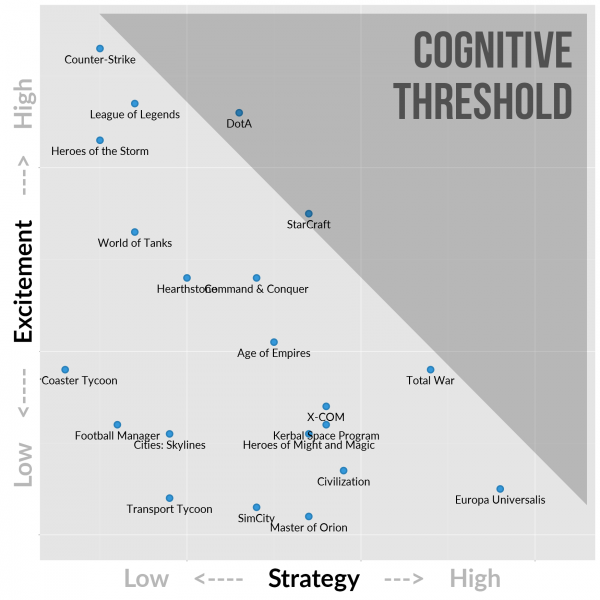
Surprisingly, while popular esports titles like Counter-Strike: Global Offensive and League of Legends ranked highly in excitement, they did not rank particularly high in strategy. Meanwhile, StarCraft, which was one of the first popular esports titles, falls almost in the exact center, being both exciting and complex.
“Engagement occurs when a game can balance the gamer’s increasing skill by increasing the game’s difficulty,” Yee explained. “If the game’s difficulty outpaces the player’s skill, the game becomes frustrating. And if the player’s skill outpaces the game’s difficulty, the game becomes boring. Here in our strategy games map, we are seeing the upper limit of challenge across games within a genre.”
You can read Yee’s full post describing Quantic Foundry’s study here (via Gamasutra).
Support our mission to keep content open and free by engaging with theCUBE community. Join theCUBE’s Alumni Trust Network, where technology leaders connect, share intelligence and create opportunities.
Founded by tech visionaries John Furrier and Dave Vellante, SiliconANGLE Media has built a dynamic ecosystem of industry-leading digital media brands that reach 15+ million elite tech professionals. Our new proprietary theCUBE AI Video Cloud is breaking ground in audience interaction, leveraging theCUBEai.com neural network to help technology companies make data-driven decisions and stay at the forefront of industry conversations.





