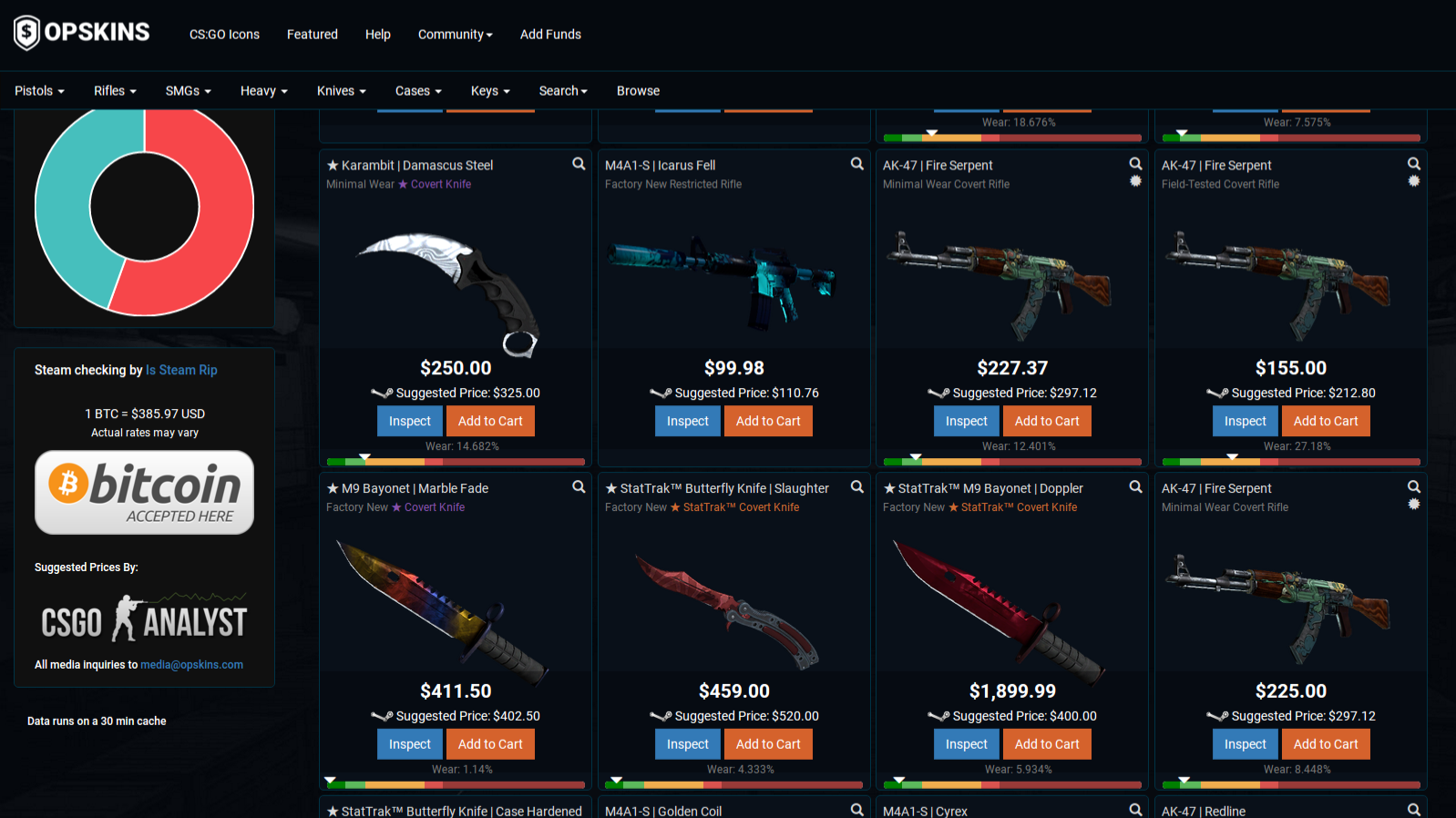







Digital clothing is a staple of video game economies–in fact, many multiplayer games essentially fund themselves by selling funny hats (looking at you Team Fortress 2). So when Bitcoin payment processor BitPay, Inc. partnered with OPSkins, a Counter-Strike: Global Offensive (CS:GO) skins trading site, it seemed like a match made for business.
CS:GO is a first-person shooter game that puts players in the position of being various this means that these “skins” are used to decorate the weapons wielded by players. The ability to trade skins arose from Valve Corporation’s Steam marketplace and some skins are rarer and more difficult to obtain than others providing prestige and value to them. As a result, some rare skins can sell for over $10,000. However, most virtual items go for much less, amid them keys used to unlock item boxes in the game sell for approximately $1.
Launched in January 2015, OPSkins Group Inc. intended to take advantage of the growing demand for a safe way to trade skins for money. The site partnered with BitPay in August last year and since then it has seen an ever-increasing demand for bitcoin transactions.
According to BitPay, the site has seen 400-500 bitcoins processed a week–at current market prices that’s approximately $156,000 and $194,000 every week. Since launch the site has sold 5 million items since its launch and sees approximately 3,000 users join a day. There’s no data on what percentage of that is the bitcoin sales, but few businesses see more than 1 percent of their sales in bitcoin.
Not long after launching, OPSkins saw a demand for bitcoin payments for CS:GO virtual items. This is not an uncommon thing nowadays for virtual item trades Team Fortress 2 trading site Dispenser.tf provides bitcoin trades. On the other side of legitimacy, Star Trek Online “gold seller” Divine Treasury accepts bitcoins for in game items (although this is against the terms of service).
Markets that bring gamers together to trade virtual items often give rise to interest in making money. And much of the massively multiplayer online (MMO) game ecosystem has flirted with the idea of real money transactions (RMT) markets involving in game items. This includes Blizzard Entertainment’s Diablo 3 (which eventually withdrew from RMT for reasons not related to accepting cash). As the market for virtual items heats up, the interest in amassing a fortune from video games brings sellers, and bitcoin transactions provide an alternative to PayPal and credit cards.
As the story goes, when a senior sales engineer at BitPay discovered OPSkins was offering skins for bitcoin from his son–an avid CS:GO player–he had the company reach out to the skin site about the BitPay’s API.
OPSkins quickly agreed to implement with BitPay and became one of the first to use BitPay’s masspay API, which is used to pay out nearly $40,000 a day in bitcoin to sellers.
One of the clear benefits of going with BitPay rather than a roll-your-own bitcoin processing solution is security and insurance for bitcoin holdings. As a result, OPSkins does not need to keep a hot wallet and can use BitPay to process the transactions.
By reaching out to merchants in the virtual item marketplace, BitPay is forging bonds that will strengthen the bitcoin ecology especially in light of how well video games and cryptocurrency mesh. Already BitPay has been slowly reaching out into the video game market in a partnership with free-to-play game publisher Bigpoint GmbH and Taiwan’s gaming wallet service GASH Point (Gamania Corporation).
Support our mission to keep content open and free by engaging with theCUBE community. Join theCUBE’s Alumni Trust Network, where technology leaders connect, share intelligence and create opportunities.
Founded by tech visionaries John Furrier and Dave Vellante, SiliconANGLE Media has built a dynamic ecosystem of industry-leading digital media brands that reach 15+ million elite tech professionals. Our new proprietary theCUBE AI Video Cloud is breaking ground in audience interaction, leveraging theCUBEai.com neural network to help technology companies make data-driven decisions and stay at the forefront of industry conversations.





