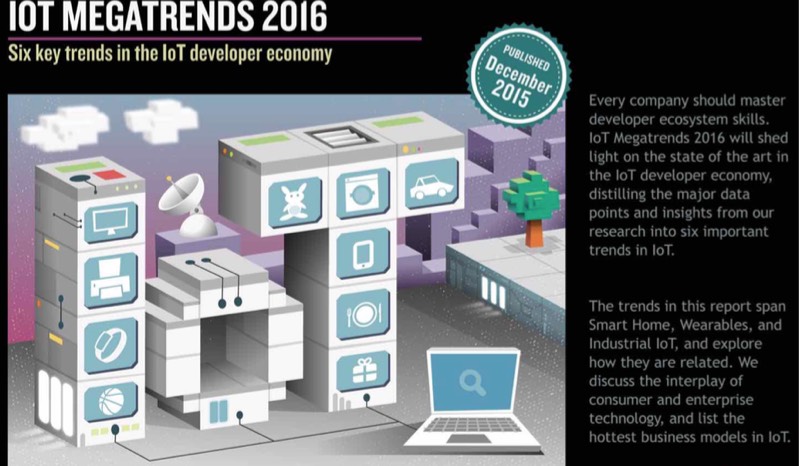







Market analyst firm Visionmobile Ltd. has released a new “megatrends” report on the Internet of Things (IoT) market that finds that despite the hype surrounding the sector, more needs to be done to sustain developer involvement.
“Developers are more and more the center of commercial strategy… if you’re not into developers, you’re not doing it right,” the report notes.
“If you believe that the Internet of Things is only about making new, stand-alone devices and solutions, then think again. Developers are the key to success in the marketplace and there are four ways developers can extend a business: as innovators, customers, extenders, and distributors,” the report goes on.
“The trend towards placing developers in the center of commercial strategy is in full swing. For example, Industrial IoT counts almost as high a percentage of professional developers as the mobile ecosystem does, while the smart home sector trails behind.”
The report notes that every major consumer technology is vying to become the hub of your home nowadays, from Amazon (Echo) and AT&T (Digital Life) to Xiaomi and Xfinity (by Comcast).
“It shouldn’t surprise then that with 1.4 million developers, the smart home is the most popular IoT sector. Smart home hubs compete on three axes – new touchpoints, new interaction models and developers – each of which raises important questions for the future. Touchpoints like voice control, next-generation remote controls, apps, and messaging are the core of the user experience, but most solutions don’t come from the maker of the smart home hub itself.
The question in the long term is who will control that customer relationship in the future, harvesting user loyalty, the report notes.
“Conversational platforms (voice, chat) in particular are coming up strong. Meanwhile, the rise of artificial intelligence fundamentally challenges the central role of developers as creators of use cases. Will developers go extinct? For now, key players still count on developers to drive value creation, also in AI-driven conversation platforms.”
If you’ve been following the IoT market you’d know that wearables continue to evolve and innovate, but while we think of devices such as the Apple Watch today, the report believes that the market will shift from consumer electronic devices to being embedded in items such as clothing.
“Soon, brands will compete on digital identity – an opportunity to create a powerful connection with users. Smartwatches and AR/VR platforms will compete on who has most apps. In smartwatches, Android Wear is under pressure from new platform challenges.”
“On the one hands, Chinese internet companies build their own Android derivatives for wearables. On the other, victims of the Android smartphone strategy build direct challenger platforms based on Tizen or webOS.”
“Our research shows that data-centric apps are more lucrative than simple smartwatch apps or new wearable devices, but that few developers go that way today.”
The report notes that the innovation focus in Connected Cars is shifting from the dashboard to vehicle data, and in the future to data-driven transportation platforms.
“Car makers struggle to keep control over and to gain access to the necessary supply chain, expertise, and data to be leaders in this evolution. Will car makers miss automotive computing just like Microsoft missed mobile?”
The company believes that the traditional split between consumer and enterprise technology is declining as both converge in many industries.
“The smart home of today will become the smart office of tomorrow, as smart locks turn into access control and smart TVs into meeting room equipment. The equivalent of wearable-sensor-driven health apps in the enterprise are people analytics, such as the Humanyze platform.”
“Consumer, and not enterprise technology will be the foundation for the converged future as consumer markets offer much faster product evolution and validation with customers.”
“Consumer-grade ease of installation coupled with enterprise-grade security will be the future.”
The report claims that the prevalent business models in the Internet of Things are moving from product sales to recurring revenue, and from products to services.
“Industrial IoT technology creates opportunities for vendors to sell access to assets like jet engines or locomotives as a service, rather than selling the machines themselves. In the home, smart appliances (e.g. washing machines) are becoming an e-commerce point of sale for consumables (e.g. washing powder).”
“Companies like Nest, Oscar Health Insurance, or Automatic have paved the way for moving from a ‘consumer pays’ model to a ‘consumer gets paid’ model, subsidizing devices with other revenue streams like insurance or energy company rebates.”
A full copy of the report is available here.
Support our mission to keep content open and free by engaging with theCUBE community. Join theCUBE’s Alumni Trust Network, where technology leaders connect, share intelligence and create opportunities.
Founded by tech visionaries John Furrier and Dave Vellante, SiliconANGLE Media has built a dynamic ecosystem of industry-leading digital media brands that reach 15+ million elite tech professionals. Our new proprietary theCUBE AI Video Cloud is breaking ground in audience interaction, leveraging theCUBEai.com neural network to help technology companies make data-driven decisions and stay at the forefront of industry conversations.





