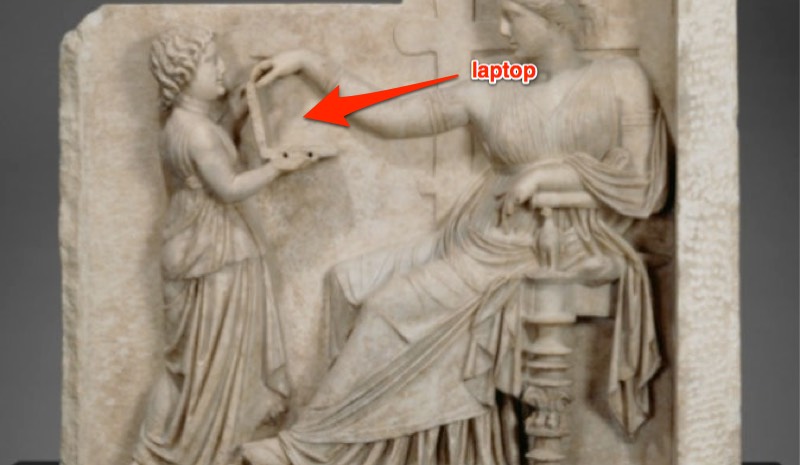







In a story worthy of an episode of History Channel’s Ancient Aliens kooks, conspiracy theorists, and other people who are likely vegan are apparently claiming that an ancient Greek funeral stele (grave marker) is proof of time travel because it includes a laptop.
The marker, named “Grave Naiskos of an Enthroned Woman with an Attendant” appears to depict a woman holding open the lid of a shallow chest, but if you use your imagination (or take some seriously heavy drugs) the chest is apparently a laptop, complete with USB ports.
It gets better, as according to The Daily Mail the laptop links in with the fable of the Oracle of Delphi, which was the most important shrine in all Greece in ancient times and apparently allowed priests to connect with the gods, aliens or time travelers who would share ‘advanced information and high-tech devices.
Conspiracy theorist and YouTuber StillSpeakingOut, one person with an interest in time travel, notes that “I am not saying that this is (definitely) depicting an ancient laptop computer…but when I look at the sculpture I can’t help but think about the Oracle of Delphi, which was supposed to allow the priests to connect with the gods to retrieve advanced information and various aspects.”
One flaw with the conspiracy is that the image clearly depicts round ports on the side of the alleged device, and USB ports are rectangular, so perhaps they’re PS/2 connectors that were prominent on ancient (modern ancient) times such as the legendary IBM Thinkpad of the early 1990s.
More seriously though there is an alternative explanation for what the object in the stele might be, and that’s a wax tablet, a device used as a reusable and portable writing surface in Antiquity and throughout the Middle Ages, that looks very similar to the one the attendant is holding.
While it might be fun to make fun of people who seriously believe this is a laptop, it should be pointed out that the Greeks are believed to have created a computer at around the same time, the still mysterious Antikythera Mechanism, an ancient analog computer designed to predict astronomical positions and eclipses for calendrical and astrological purposes, that was discovered in a shipwreck in 1900.
It should be noted though that the Antikythera Mechanism didn’t have an LCD screen.
If you’re interested in checking the Stele out for yourself it’s held in the collection of the J. Paul Getty Museum in Malibu, California.
Support our mission to keep content open and free by engaging with theCUBE community. Join theCUBE’s Alumni Trust Network, where technology leaders connect, share intelligence and create opportunities.
Founded by tech visionaries John Furrier and Dave Vellante, SiliconANGLE Media has built a dynamic ecosystem of industry-leading digital media brands that reach 15+ million elite tech professionals. Our new proprietary theCUBE AI Video Cloud is breaking ground in audience interaction, leveraging theCUBEai.com neural network to help technology companies make data-driven decisions and stay at the forefront of industry conversations.





