







Gaming and industrial graphics card chipmaker Nvidia Corporation has seen a record year—with 2016 fiscal revenue $5.01 billion, up 7 percent from $4.68 billion from last year. Quarterly earnings reported by Nvidia for Q4 2016 revenue hit $1.40 billion, up 12 percent from $1.25 billion in Q4 2015.
“We had another record quarter, capping a record year,” said Jen-Hsun Huang, co-founder and chief executive officer of Nvidia.
“Our strategy is to create specialized accelerated computing platforms for large growth markets that demand the 10x boost in performance we offer. Each platform leverages our focused investment in building the world’s most advanced GPU technology.”
To capitalize on these record revenues, Nividia’s CEO said the company has set its sights on four pillars of the evolving graphics computing industry: PC gaming, virtual reality, deep learning and self-driving cars.
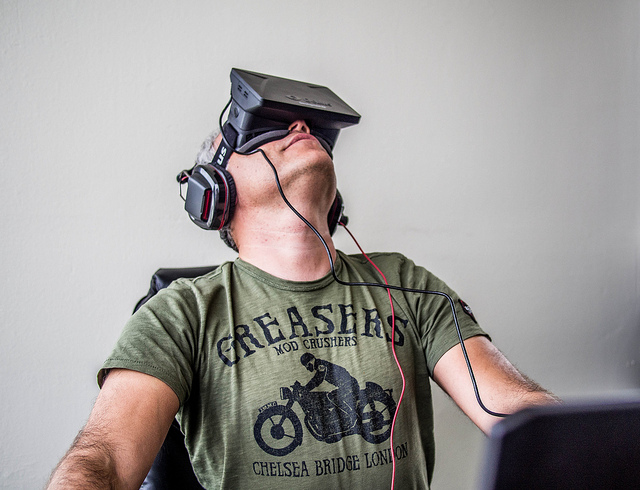
PC gaming and virtual reality go hand-in-hand for Nvidia with 2016 being the year that every VR headset will be launched from the Oculus Rift, HTC Vive, and the PlayStation VR. In 2015, Nvidia estimated that less than 1 percent of the world’s 1.43 billion computers (expected in use in 2016) would be able to handle VR experiences. As a result, the company launched the GeForce GTX VR Ready program and GeForce GTX 970 and 980 cards are part of the Oculus Rift pre-order VR bundles (available as of February 16, 2016).
“We are especially excited about deep learning,” Huang added, “a breakthrough in artificial intelligence algorithms that takes advantage of our GPU’s ability to process data simultaneously.”
Deep learning refers a computing model that allows computers to teach themselves how to find patterns in large amounts of data and make predictions based on that data. This is a core concept in the Big Data industry and recently the company signed up to provide China’s Alibaba Group Holding Limited’s cloud-computing AliCloud platform with Nvidia’s industrial GPU computer chips. Nvidia GRID N-series virtual machines are also available on Microsoft’s Azure cloud and Amazon, Inc.’s Amazon Web Services cloud as well.
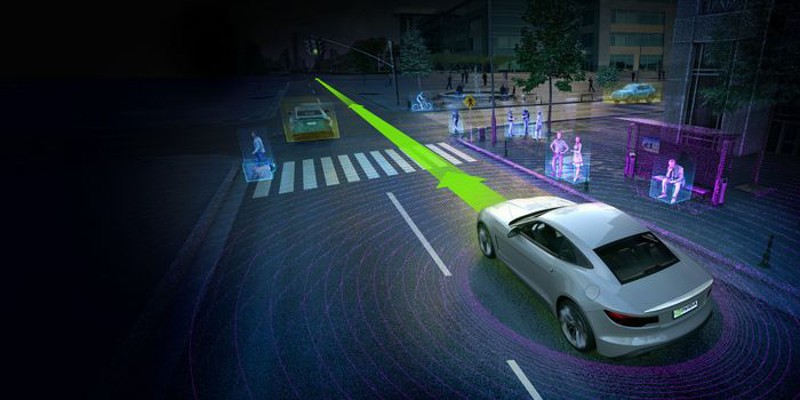
When it comes to self-driving cars, Nvidia’s is the monster-computing platform the first-gen Drive PX 2. According to the company, the Drive PX 2 is capable of delivering up to 24 billion deep learning operations per second with its 12 CPU cores and four GPUs. The system crams 8 teraflops of processing power into a “brain” for self-driving cars with as much power as six Titan X graphics cards or the equivalent of 150 MacBook Pros.
Google (a unit of Alphabet, Inc.) has been on the forefront of self-driving cars and autonomous vehicles for years with numerous tests. Recently Ford Motor Company and Google partnered to build the next-gen of self-driving cars and the U.S. government made plans to commit more than $4 billion for pilot programs to develop autonomous vehicles throughout the states.
Making the self-driving car even more interesting, the National Highway Traffic Safety Administration recently told Google that the computer in a self-driving car can be considered a “driver” for purposes of regulation.
Support our mission to keep content open and free by engaging with theCUBE community. Join theCUBE’s Alumni Trust Network, where technology leaders connect, share intelligence and create opportunities.
Founded by tech visionaries John Furrier and Dave Vellante, SiliconANGLE Media has built a dynamic ecosystem of industry-leading digital media brands that reach 15+ million elite tech professionals. Our new proprietary theCUBE AI Video Cloud is breaking ground in audience interaction, leveraging theCUBEai.com neural network to help technology companies make data-driven decisions and stay at the forefront of industry conversations.





