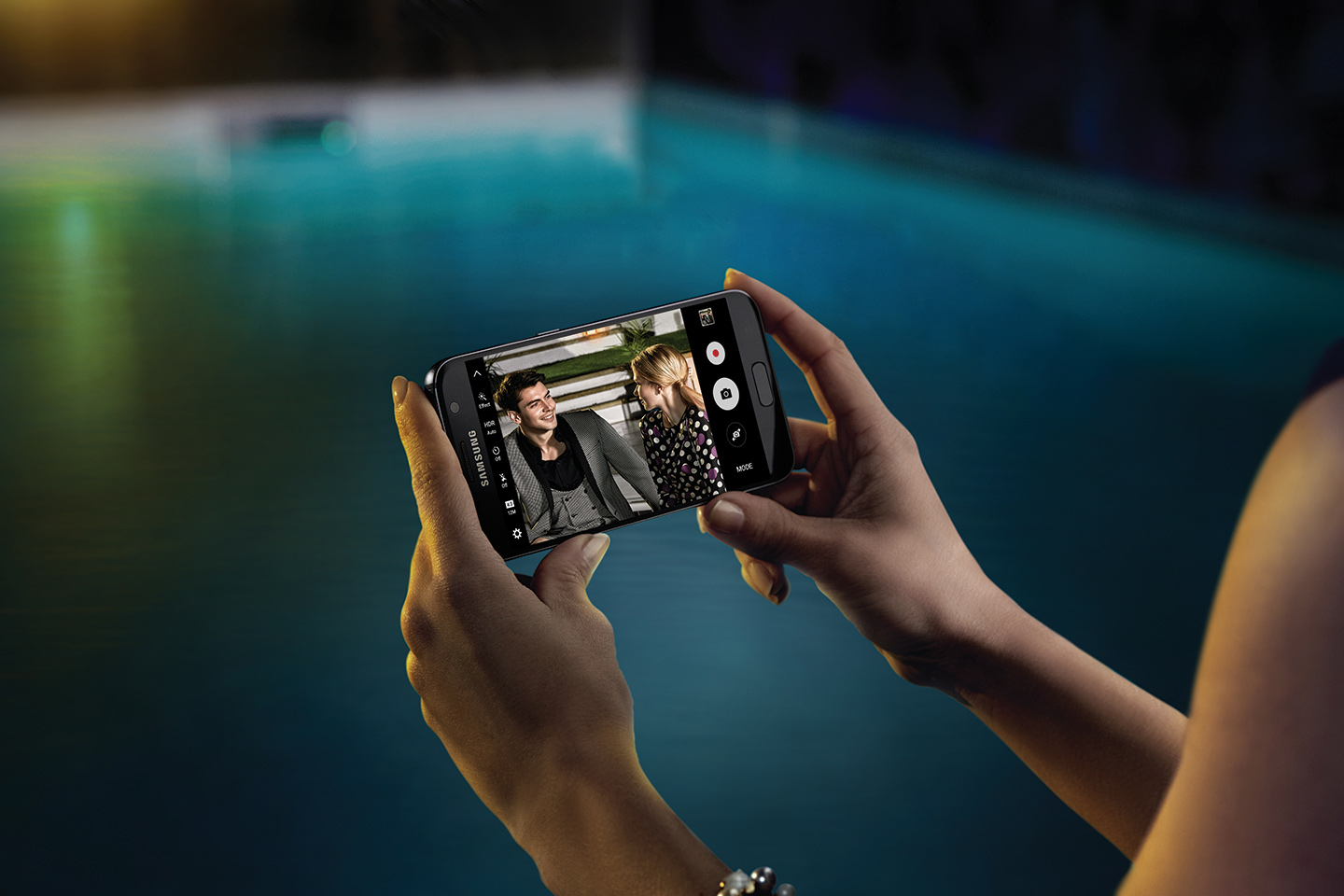







Samsung Electronics Co. Ltd. on Sunday unveiled the Galaxy S7 and S7 edge, its latest flagship smartphones.
Along with subtle design changes, upgraded processors, water and dust resistance, and the return of microSD support, Samsung gave the main camera on its latest devices an upgrade and added some new shooting modes and a selfie flash.
Despite a lower pixel count than last year’s Galaxy S6 and S6 edge — down to 12-megapixels from 16-megapixels — Samsung has introduced a new Dual Pixel image sensor that it claims delivers sharper, brighter images, even in low light.
Samsung says its Dual Pixel technology delivers a brighter lens with wider aperture and bigger pixels which result in a faster shutter speed and more accurate autofocus even in low-light conditions. But how does it work?
The Galaxy S7’s Dual Pixel image sensor splits every single pixel into two photodiodes for on-chip detection, delivering faster and more accurate autofocus.
Also found on high-end DSLR cameras, Dual Pixel tech sends light from the lens to two separate image sensors to adjust focus, in much the same way as the human eye does.
Samsung says only one percent of image sensor pixels of the Galaxy S6 were capable of recognizing phase and contrast. By comparison, 100 percent of the image pixels of the Galaxy S7 can recognize phase and contrast.
If that’s all too technical, the difference in image and video quality is clearly demonstrated in the two videos below:
The improvements delivered by the Dual Pixel sensor is most obvious when taking photos or video in low-light conditions, as demonstrated above. The Galaxy S7’s camera has 1.4um pixels (56 percent more than the Galaxy S6) and a larger F1.7 aperture (allowing 25 percent more light in) which, when combined, results in 95 percent more light being let in compared to the Galaxy S6’s lens.
View images shot with the Galaxy S7 here.
The new Motion Panorama Shot lets users record subject movements when shooting in Panorama Shot mode. This delivers images as “vivid and vibrant as videos,” claims Samsung. To view these movements, simply swipe the captured panorama image or move the actual device.
New to the Galaxy S7 is Hyperlapse that allows users to compress hours of video footage into seconds to illustrate subject movement and the time passing. The Galaxy S7 will automatically pick soft and stable frames, combined with Video Digital Image Stabilization, to create a stable time lapse (Hyperlapse) video.
Shooting speed is also automatically adjusted, with slow moving subjects shot faster and vice versa.
See the Galaxy S7’s new Hyperlapse feature in action below:
The 5-megapixel front-facing (selfie) camera has an F1.7 lens to deliver bright selfie even in low-light conditions.
If this is not enough, there is a new Selfie Flash that employs the AMOLED display (just like Apple’s Retina Flash) as a flash when taking selfies in a dark setting.
In addition, there’s a new Beauty Shot mode that adds a 3D lighting effect to selfies as well as a Wide Selfie Shot mode for a panorama effect.
See the Galaxy S7’s new selfie camera and flash in action below:
Support our mission to keep content open and free by engaging with theCUBE community. Join theCUBE’s Alumni Trust Network, where technology leaders connect, share intelligence and create opportunities.
Founded by tech visionaries John Furrier and Dave Vellante, SiliconANGLE Media has built a dynamic ecosystem of industry-leading digital media brands that reach 15+ million elite tech professionals. Our new proprietary theCUBE AI Video Cloud is breaking ground in audience interaction, leveraging theCUBEai.com neural network to help technology companies make data-driven decisions and stay at the forefront of industry conversations.





