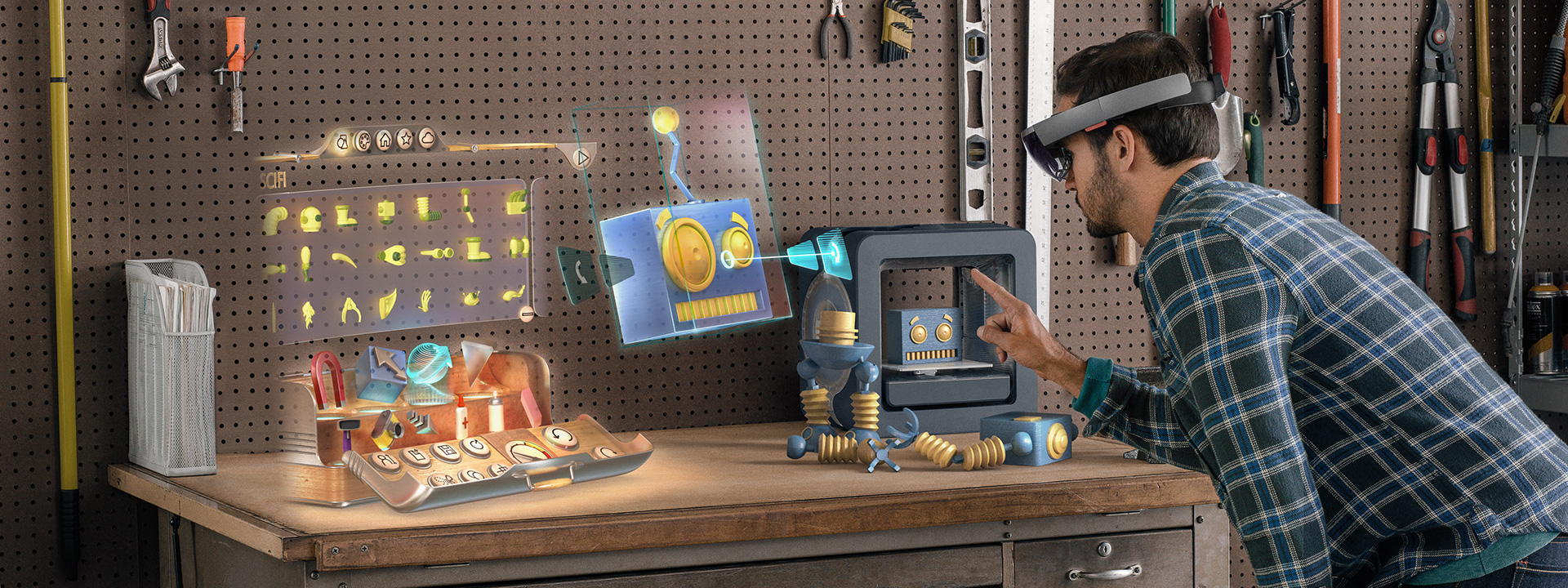







While we knew last year that Microsoft’s augmented reality (AR) headset HoloLens wasn’t going to be released to the general public for some time, we also knew at the same time that the developer kit would be coming in the first quarter of 2016.
This has now been set in stone following Microsoft’s announcement that pre-orders of the Microsoft HoloLens Development Edition are available and will start shipping in the U.S. and Canada March 30th. The cost, as earlier reported in 2015, will be $3,000. This may seem like a lot of money, but we should remember that unlike some other virtual reality devices (HoloLens is actually AR) such as Oculus Rift or Samsung Gear VR, the HoloLens is self-contained. This means you don’t have to use it with a smartphone or a powerful PC.
Alex Kipman, a Technical Fellow for new device categories in the Operating System Group at Microsoft and the man said to be HoloLens’ main creator, discussed in a blog post about Microsoft and HoloLens’ many partners, that include Volo Cars and the now successful (one headset was blown-up in space) partnership with NASA and headset wearing spacemen.
In the post Kipman said that the announcement marked a “monumental” day for Microsoft, paving the way for days in the future in which everyday folks will be merging holographic images with the real world.
Kipman, with world-changing resonance, said, “The future of technology will not be confined to just two dimensions – our future interaction with technology will more closely mirrors our real world. Technology coexisting in our real, three-dimensional world, beyond screens and pixels. We believe that the future is holographic, and as a result, we will continue to empower the developers who will help bring that future to life.”
As for developers, they can expect to receive the fully self-contained (no phone, annoying wires, markers, external cameras or other computers) kit with hundreds of UWP (Universal Windows Platform) apps through the Windows Store. These include OneDrive, Maps, Remote Desktop, People, Movies and TV, Groove Music and Microsoft Office apps. Developers will also receive holographic app experiences to give them an idea about what can be developed. You can learn more about that here.
Support our mission to keep content open and free by engaging with theCUBE community. Join theCUBE’s Alumni Trust Network, where technology leaders connect, share intelligence and create opportunities.
Founded by tech visionaries John Furrier and Dave Vellante, SiliconANGLE Media has built a dynamic ecosystem of industry-leading digital media brands that reach 15+ million elite tech professionals. Our new proprietary theCUBE AI Video Cloud is breaking ground in audience interaction, leveraging theCUBEai.com neural network to help technology companies make data-driven decisions and stay at the forefront of industry conversations.





