






Many of the most ambitious attempts by Google Inc., Facebook Inc., and others to spread Internet access around the world have focused on the skies: satellites, laser-assisted drones, and balloons that can provide broad coverage to wide areas both in rural areas and in cities in less developed countries with slow 3G or 2G connections.
Today, Facebook brought its drive for universal access back down to Earth. At its F8 developer conference in San Francisco, it introduced two new ground-based broadband access technologies that it says will provide better broadband at lower cost than laying fiber optic cables or installing more wireless base stations using expensive new radio frequency spectrum.
“We want to accelerate how people get connected to the Internet,” said Jay Parikh, vice president of engineering and head of Facebook’s infrastructure.
The idea isn’t entirely altruistic, of course, though Facebook does plan to make the technologies available publicly once it proves out the concepts. The more people who can get online especially with high-speed connections, the more people can use all of Facebook’s services and Facebook can sell more ads to reach them.
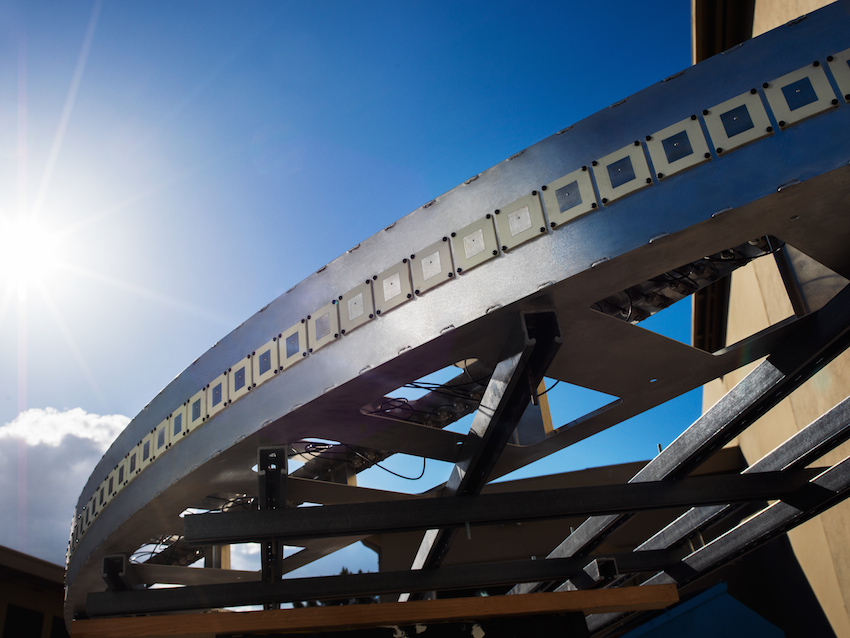
First, Facebook’s two-year-old Connectivity Lab introduced Project ARIES (for Antenna Radio Integration for Efficiency in Spectrum), which is a way to provide services to more devices using the same frequency spectrum. It’s a base station (prototype pictured) with 96 antennas that can support 24 simultaneous streams over the same spectrum.
The technology is aimed at rural areas with slow networks. Facebook thinks ARIES could allow 10 times the number of users at one time even compared with 4G networks, and also provide it over larger distances. Parikh said some 97 percent of people live within 40 kilometers of a city, so this kind of technology could connect them.
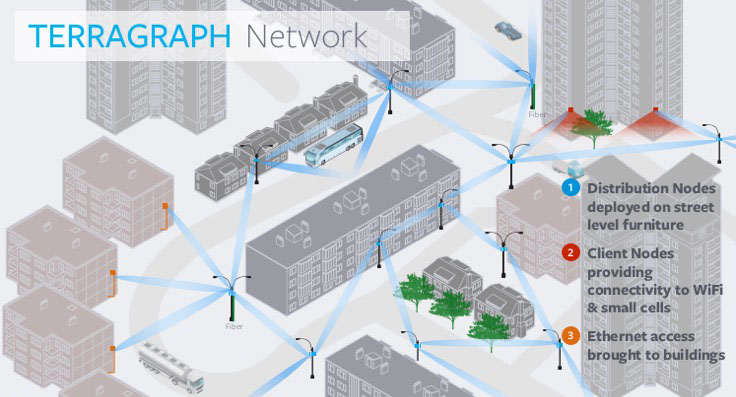
The other project, called Terragraph, is a wireless system intended to bring high-speed Internet to more dense urban areas. Using cheap WiGig chips designed for consumer electronics, it employs the unlicensed 60 GHz frequency band that has been avoided for most uses because signals are often absorbed by water and even air, limiting range.
But those limits also mean that there’s less congestion and interference among multiple wireless nodes located as little as 200 meters apart on utility poles and other “street furniture,” Parikh said. Coupled with WiFi access points, they could provide 100 percent street-level coverage.
Currently testing Terragraph in its own headquarters, Facebook today announced a trial in the city of San Jose’s downtown, going live next year. The company plans to expand to more cities around the world.
With no desire to operate dumb pipes, Facebook doesn’t plan to go beyond building trial networks. It aims to contribute the technologies via its Telecom Infra Project.
Support our mission to keep content open and free by engaging with theCUBE community. Join theCUBE’s Alumni Trust Network, where technology leaders connect, share intelligence and create opportunities.
Founded by tech visionaries John Furrier and Dave Vellante, SiliconANGLE Media has built a dynamic ecosystem of industry-leading digital media brands that reach 15+ million elite tech professionals. Our new proprietary theCUBE AI Video Cloud is breaking ground in audience interaction, leveraging theCUBEai.com neural network to help technology companies make data-driven decisions and stay at the forefront of industry conversations.





