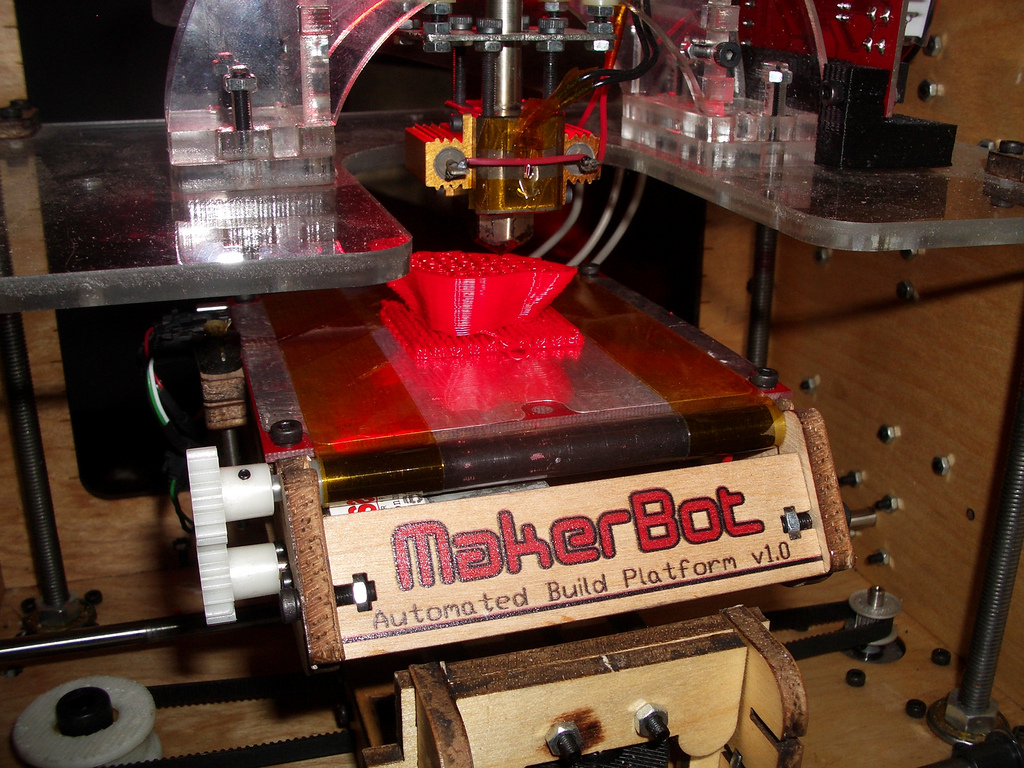







More and more consumers are jumping on the 3D printing bandwagon as 3D printers continue to become cheaper and more powerful, but according to Pirate Party founder Rick Falkvinge, a recent change to copyright law in the United Kingdom could threaten the future of this growing movement.
Last month, the UK followed an example set by the European Union by extending copyrights for designs from a 25 years to 70 years after the death of the designer. This puts copyright on designs on par with similar laws for literature and film, but in a recent article for Private Internet Access (via Ars Technica), Falkvinge calls the new law for designs “a direct assault on the 3D printing revolution.”
“The obvious first argument [against the law] is that the very existence of exclusive rights are justified by allegedly incentivizing the design process. ‘You come up with something good, you get a monopoly on exploiting it commercially for 25 years,'” Falkvinge said. “Therefore, extending the monopoly term retroactively makes no sense at all – somebody is not going to change their minds 25 years ago because of changes to law today. Designs that already exist won’t stop existing because of later legislative efforts. Therefore, moving designs out of the public domain is arguably stealing from that public domain, as it negates property rights of makers.”
“The second odd observation is that the UK law in question commingles patent law and copyright law, which are rather different beasts,” Falkvinge continued. “Furniture is normally protected by something known as a design patent and not by copyright, and this has enormous ramifications for 3D printing: when something is under patent, you’re absolutely and one hundred percent free to make copies of it for your own use with your own tools and materials. When something is under copyright, you are not.”
Falkvinge argued that the law will lead to prosecution against anyone who manufactures their own furniture using their own tools. He noted that this outcome is purely a result of the way copyright and patent law work in Europe versus the way they work in the United States.
“So in the United States, a change from patent protection to copyright protection would not matter much when it comes to maker culture and 3D printing. In the European Union, which is where this is taking place, it matters a whole lot.”
Support our mission to keep content open and free by engaging with theCUBE community. Join theCUBE’s Alumni Trust Network, where technology leaders connect, share intelligence and create opportunities.
Founded by tech visionaries John Furrier and Dave Vellante, SiliconANGLE Media has built a dynamic ecosystem of industry-leading digital media brands that reach 15+ million elite tech professionals. Our new proprietary theCUBE AI Video Cloud is breaking ground in audience interaction, leveraging theCUBEai.com neural network to help technology companies make data-driven decisions and stay at the forefront of industry conversations.





