






Now that, as experts forecast, every business must become an IT business, radical growth presents a double-edged sword. While great for your bottom line, it may present a quagmire to your IT team. How will existing systems handle the new demands, the data influx, the storage requirements? To avoid that “snake swallowing a basketball” feeling, it would pay for growing businesses to look for ultra scalable IT — especially storage.
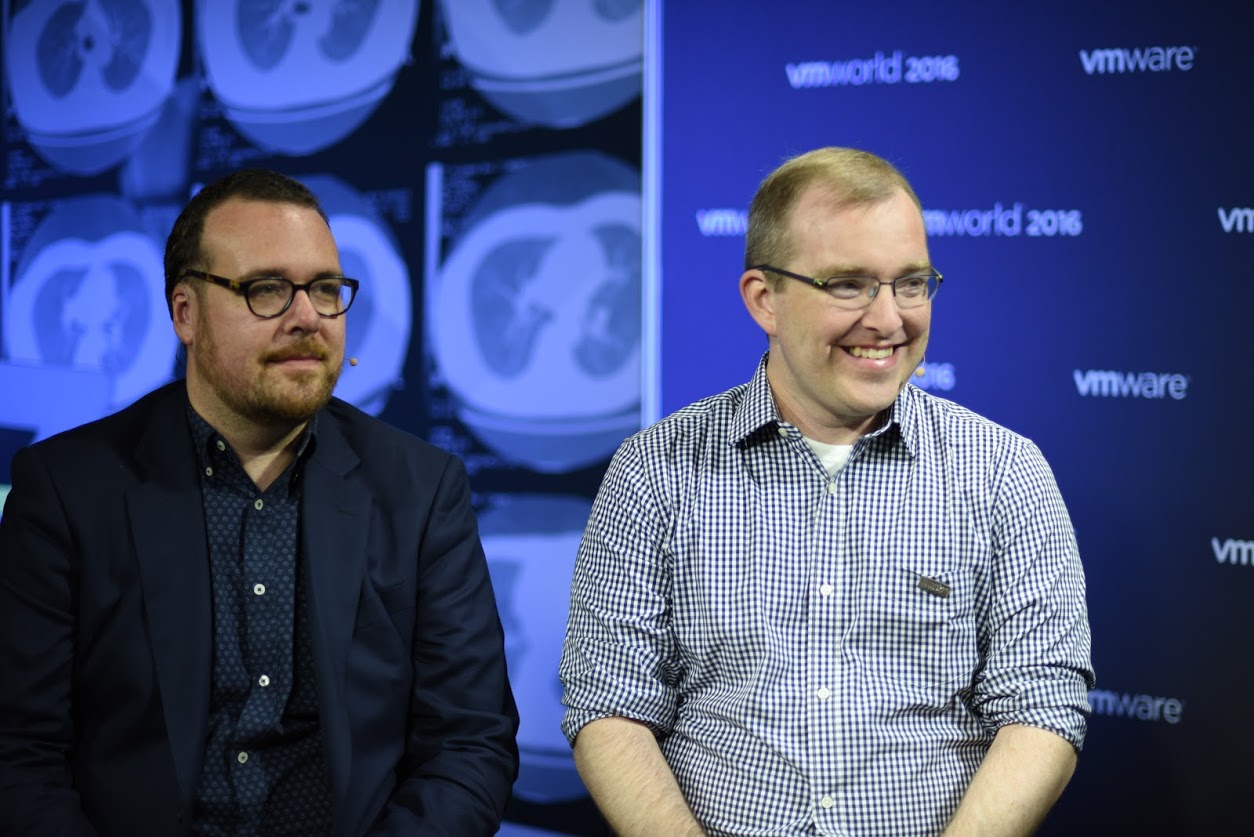
Brian Carmody, CTO of Infinidat, Inc., and Matt Rademacher, infrastructure architect at DSW, Inc., spoke with Stu Miniman (@stu) and Marc Farley (@gofarley), host and guest host of theCUBE, from the SiliconANGLE Media team, during VMworld 2016. Rademacher spoke about the challenges facing a company entering the Digital Age while wildly growing.
“We are heavily focused on merging our dot com environments with our store, and digital mesh is a big piece right now,” he said.
Rademacher said that he knew enabling a super scalable storage layer was the first order of business and said lots of folks were quick to advise the company just go with all-flash. But something about Infinidat’s differentiation — its architecture-first, media-second approach — piqued his interest.
The company brought Infinidat in-house, ran a proof of concept and tested it with real-life workloads. “The best way to reduce risk when you make a change in your IT environment is to have a very accurate model of what that workload is going to look like when you start to bring that workload over to new technology,” Carmody explained.
DSW has seen a huge improvement in scalability and speed; four-hour tasks have been cut down to seven minutes, and batch processing that once took six hours is now complete in 40 minutes, Rademacher said.
DSW’s low baseline Input/Output Operations Per Second was negatively impacting business, according to Carmody.
“That was latent demand that was not being serviced, because of latency limitations,” he said. He explained that removing one bottleneck can often lift up an entire business, and a job in infrastructure can be summed up as “just finding new bottlenecks and making them go away.”
Watch the complete video interview below, and be sure to check out more of SiliconANGLE and theCUBE’s coverage of VMworld 2016.
Support our mission to keep content open and free by engaging with theCUBE community. Join theCUBE’s Alumni Trust Network, where technology leaders connect, share intelligence and create opportunities.
Founded by tech visionaries John Furrier and Dave Vellante, SiliconANGLE Media has built a dynamic ecosystem of industry-leading digital media brands that reach 15+ million elite tech professionals. Our new proprietary theCUBE AI Video Cloud is breaking ground in audience interaction, leveraging theCUBEai.com neural network to help technology companies make data-driven decisions and stay at the forefront of industry conversations.





