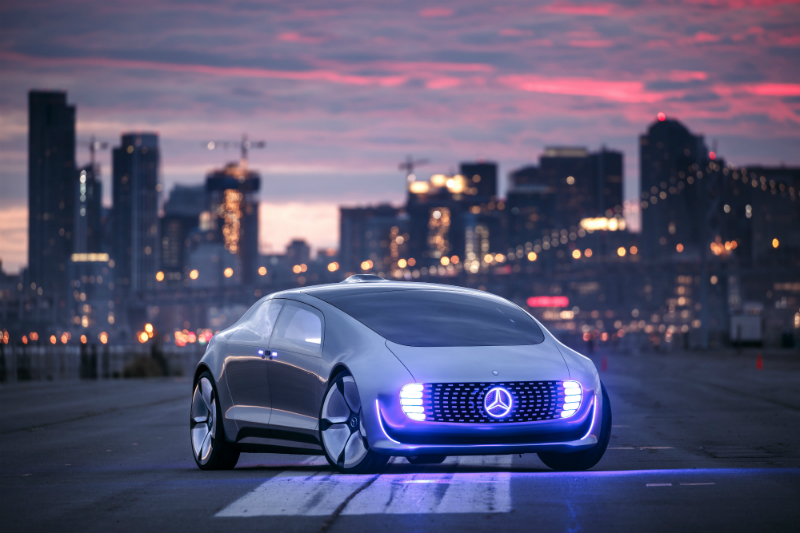







The competition is constantly increasing between automakers and various tech companies to develop self-driving cars and so too is the technology advancing at a rapid pace. As more and more companies enter the growing market, the demand for talented engineers is rising rapidly.
That’s why the online education company Udacity is focusing on education and has created a nanodegree program to train self-driving car engineers. Sebastian Thrun (below), the co-founder of Udacity who previously worked on Google’s self-driving car program, yesterday said Udacity has added the nine-month nanodegree program to its offering to help familiarize engineers with autonomous car technology.
“Self-driving car engineers are in demand,” Thrun said in an appearance at the TechCrunch Disrupt conference in San Francisco, where he spoke about the new nano-degree. But he added, “No university has a degree in self-driving cars.”
Udacity has forged partnerships with some big names in the self-driving car market to ensure students are fully prepared and are able to fast-track their careers upon graduation. Partners include Mercedes-Benz, a division of Daimler AG, and Nvidia Corp. Mercedes-Benz is currently running tests to incorporate Nvidia’s ‘supercomputer’ the Drive PX 2 into its autonomous vehicles.

Other partners for Udacity’s self-driving car nanodegree include self-driving truck startup, Otto, which was acquired by Uber Technologies Inc. last month for $680 million, as well as Chinese ride-hailing giant Didi Chuxing Technology Co.
The nine-month program consists of three terms of 12 weeks each, costing $800 per term. The nanodegree will cover topics such as “deep learning, computer vision, sensor fusion, localization and controllers” Thrun said in a blog post. Udacity also has its own autonomous vehicle, which students will be able to run their code on. “If you see a car with a Udacity logo, run as fast as you can the other way,” Thrun joked.
Apart from his previous self-driving car experience with Google, Thrun, who is one of the instructors for the nanodegree, also led the team at Stanford University who built the autonomous car Stanley. The project went on to win the 2005 DARPA Grand Challenge.
Those interested in applying can learn more at udacity.com/drive. The application process closes on Sept. 27 and applicants will hear back by Oct. 3 if they have been accepted, with classes starting mid-October. Applicants must have prior experience in Python or another scripting language as well as some background in probability, statistics and calculus.
The self-driving car nanodegree is limited to 250 seats and at the time of writing, Udacity had already received over 1,700 applications.
With reporting from Robert Hof in San Francisco.
Support our mission to keep content open and free by engaging with theCUBE community. Join theCUBE’s Alumni Trust Network, where technology leaders connect, share intelligence and create opportunities.
Founded by tech visionaries John Furrier and Dave Vellante, SiliconANGLE Media has built a dynamic ecosystem of industry-leading digital media brands that reach 15+ million elite tech professionals. Our new proprietary theCUBE AI Video Cloud is breaking ground in audience interaction, leveraging theCUBEai.com neural network to help technology companies make data-driven decisions and stay at the forefront of industry conversations.





