







When Google launched its Translate service a decade ago, the Internet was pretty much devoid of digital language translation tools. Google Translate became more useful over time, but it could also be catastrophic if one had serious work to do, leading many people to doubt these tools would ever work well.
That was then. On Tuesday, Google announced that it has created an AI translation tool, called the Google Neural Machine Translation system (GNMT), that is 60 percent more accurate than the Google Translate we all know. The new tool, which uses a so-called Phrase-Based Machine Translation algorithm, is embarrassing its former Google Translate tool in a translation stand-off and, more important, just about equaling the score of human translators.
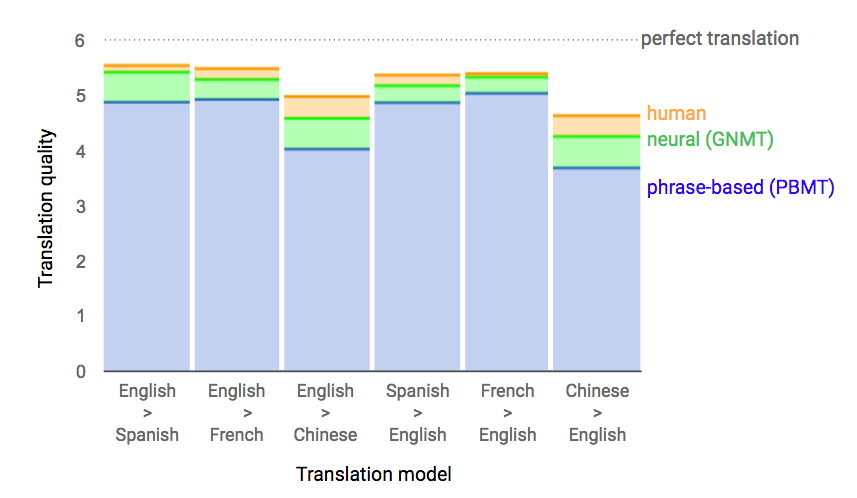
Tests show that when translating Spanish to English, Google Translate scored 3.6 in an accuracy test. 6 is the perfect translation while 0 is equal to “total nonsense.” Google’s new translation tool scored a 5 in the test, while human translators, according to the report, generally score around 5.1. We must remember these are cognate languages, meaning almost 40 percent of words in both languages are related. But Google is so confident that its first release of GNMT will be English-Mandarin Chinese.
Google explains in a technical report just how it works:
Our model consists of a deep LSTM network with 8 encoder and 8 decoder layers using attention and residual connections. To improve parallelism and therefore decrease training time, our attention mechanism connects the bottom layer of the decoder to the top layer of the encoder. To accelerate the final translation speed, we employ low-precision arithmetic during inference computations. To improve handling of rare words, we divide words into a limited set of common sub-word units (“wordpieces”) for both input and output.
In laymen’s terms, LSTM, for long short-term memory, works as our own memories work when translating language. Short-term memory can find the best translation for one word, but long-term memory will remember complex or unusual word orders. The old Google Translate method just broke down sentences by words or phrases, but didn’t remember entire complex sentences. That’s why some translations, especially using idiomatic expressions, might end up looking hilarious, profound or insulting.
“What we have now is not perfect. But you can tell that it is much, much better,” Google engineer Mike Schuster told Wired. As Wired pointed out, there’s now a big race in which tech giants are competing to create the perfect translation machine with the aid of neural networks. Peter Lee, a corporate vice president at Microsoft Research who helps lead some AI research at the company, said Microsoft is “racing against everyone… We’re all on the verge.”
Support our mission to keep content open and free by engaging with theCUBE community. Join theCUBE’s Alumni Trust Network, where technology leaders connect, share intelligence and create opportunities.
Founded by tech visionaries John Furrier and Dave Vellante, SiliconANGLE Media has built a dynamic ecosystem of industry-leading digital media brands that reach 15+ million elite tech professionals. Our new proprietary theCUBE AI Video Cloud is breaking ground in audience interaction, leveraging theCUBEai.com neural network to help technology companies make data-driven decisions and stay at the forefront of industry conversations.





