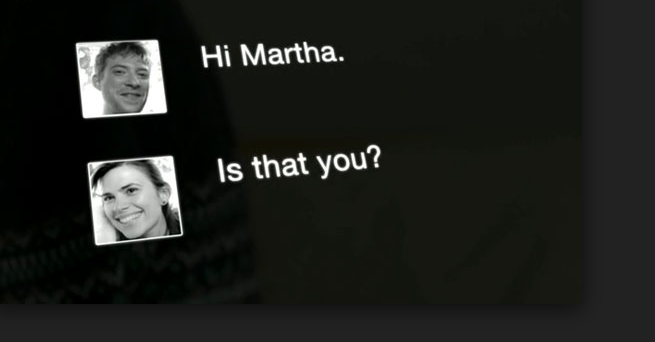







Arguably the creepiest installment of the outstanding, tech-influenced horror series, “Black Mirror“, is the episode in which a grief stricken woman brings her boyfriend back from dead. “I’ll Be Right Back” and the entire “Black Mirror” series – a new U.S. version of which is coming to Netflix very soon – takes emerging computer technology seriously: The future might be outlandish, and rather dark at times, but the depictions also resonate with viewers.
In the series the grieving lady, pining for her deceased boyfriend, spends most of her dark days re-reading his Facebook page and watching video clips the two made together. She then reads somewhere that an app is available which collects the entirety of a person’s digital footprint. An algorithm then re-creates the personality so it can interact with an interlocutor, behaving according to the nature of the missing person.
The proposition of such a technology is hardly mind-blowing. After all, chatbots, or conversational agents, have been around for some time now, even if the most advanced chatbots won’t be fluent in British sarcasm anytime soon. Nonetheless, the prospect of this happening in real life might seem farfetched.
“This is all very bad.”
This was a reply given to Eugenia Kuyda after she had informed her friends that with the help of AI, she had re-created her dearly departed friend, Roman Mazurenko, after he had been hit by a car in Moscow. One of her friends even asked if she had not learned from watching “Black Mirror.” According to reports, Kuyda had thought long and hard about bringing her friend back.
Kuyda did the same as the company in “Black Mirror.” She took all of Mazurenko’s messages and then fed them into a neural network that had been created by developers at her start-up business. It sounds larger than life, but according to The Verge the newborn’s first words were, “You have one of the most interesting puzzles in the world in your hands … . Solve it.”
Mazurenko, who in life before death had also worked as an artificial intelligence developer, had apparently “longed to see the Singularity.” She had applied for a Y Combinator fellowship with a proposal to build a cemetery, a “memorial forest” in which the dead fertilize their resting place, and at the same time their virtual identity would be preserved in the spot. He had a thing about living forever. In a way, he still does.
Bringing back Roman from the ashes was not to all of his friends’ liking, although his mother was reported as saying, “It’s not virtual reality. This is a new reality, and we need to learn to build it and live in it.” His dad was less enamored with the intelligent design, saying, “Yes, it has all of Roman’s phrases, correspondences. But for now, it’s hard — how to say it — it’s hard to read a response from a program. Sometimes it answers incorrectly.”
For the whole story and some fairly uncanny transcripts, head over to The Verge.
Support our mission to keep content open and free by engaging with theCUBE community. Join theCUBE’s Alumni Trust Network, where technology leaders connect, share intelligence and create opportunities.
Founded by tech visionaries John Furrier and Dave Vellante, SiliconANGLE Media has built a dynamic ecosystem of industry-leading digital media brands that reach 15+ million elite tech professionals. Our new proprietary theCUBE AI Video Cloud is breaking ground in audience interaction, leveraging theCUBEai.com neural network to help technology companies make data-driven decisions and stay at the forefront of industry conversations.





