 WIKIBON
WIKIBON
WIKIBON






WIKIBON

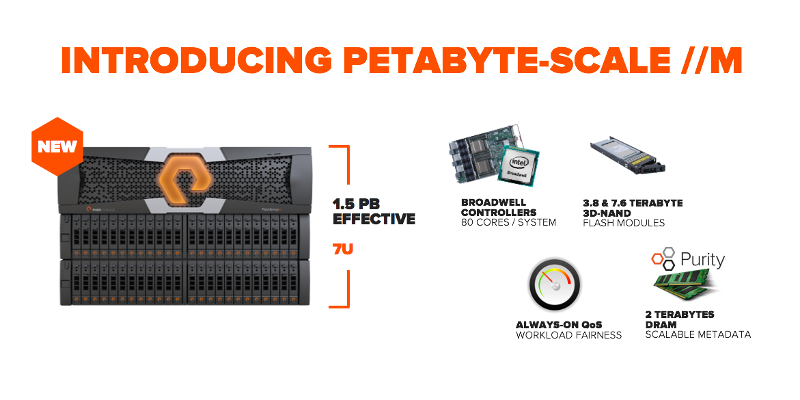
As the density of solid-state memory continues to increase thanks to innovations like 3D NAND, flash array vendors are able to squeeze more and more capacity into their systems. Today, it’s Pure Storage Inc. that is upping the ante by introducing a new petabyte-scale iteration of its flagship FlashArray//m series.
At the center of the upgrade is the top-end m70 model, which can now be equipped with beefy 3.8-terabyte and 7.6-terabyte 3D NAND modules to provide up to 512 terabytes of raw capacity. Pure says that built-in data reduction functionality makes it possible to store as much as 1.5 petabytes of information on the system in certain scenarios. And it’s all accommodated in a 7U form factor, making the array about six times denser than the company’s first-generation systems from 2012 according a blog post by Matt Kixmoeller, its vice president of operations.
The executive added that the m70 is also considerably faster thanks to an enhanced controller based on Intel Corp.’s latest Broadwell processor series. With 80 cores at full capacity, the system can handle up to 370,000 32K input/output operations per second.
The CPU refresh is joined an equally significant update to the controller’s middleware that brings so-called Network Port ID Virtualization functionality. According to Pure, the capability can automatically offload the traffic intended for a controller to other nodes if it’s undergoing maintenance to reduce the management burden on administrators and, more importantly, eliminate downtime.
It’s part of a broader effort from the company to improve the resilience of its systems. Pure claims that it has recorded an average uptime of 99.9999 percent across the FlashArray//m install base since the series started shipping last year, which amounts to just 31.5 seconds of downtime per year. And it wants to help customers achieve equally reliable application performance by rolling out a new automated quality-of-service mechanism as part of today’s update.
The addition aims to prevent services from taking up too many hardware resources by throttling usage when a workload starts taking up capacity or processors needed by its peers. Pure thus hopes to gain an edge over rivaling vendors like Nimble Storage Inc. that require administrators to set fixed utilization caps on their applications, which can be cumbersome in large-scale environments.
Support our mission to keep content open and free by engaging with theCUBE community. Join theCUBE’s Alumni Trust Network, where technology leaders connect, share intelligence and create opportunities.
Founded by tech visionaries John Furrier and Dave Vellante, SiliconANGLE Media has built a dynamic ecosystem of industry-leading digital media brands that reach 15+ million elite tech professionals. Our new proprietary theCUBE AI Video Cloud is breaking ground in audience interaction, leveraging theCUBEai.com neural network to help technology companies make data-driven decisions and stay at the forefront of industry conversations.





