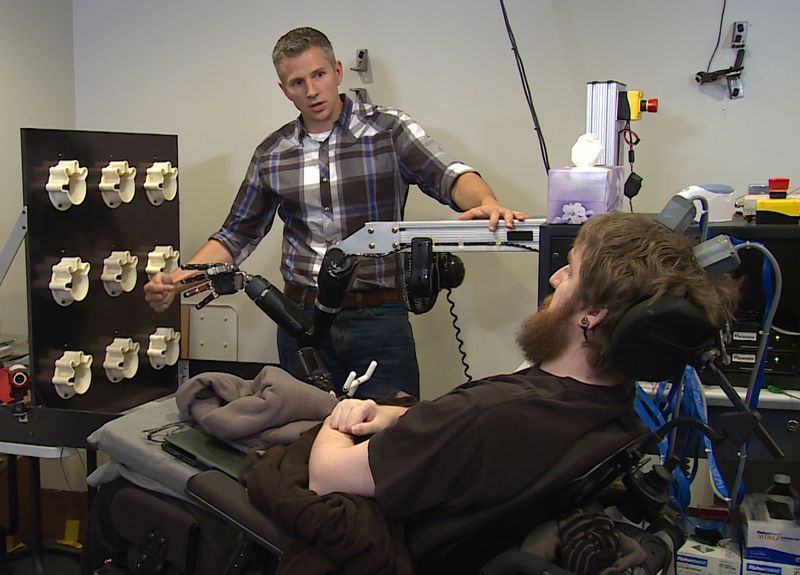







It was more than decade ago that Nathan Copeland had the experience of touching something with his hands. Following a catastrophic car crash that injured his spinal cord, Copeland was paralyzed and lost all feeling in his fingers.
Now, thanks to medical breakthroughs at the University of Pittsburgh Medical Center, he can feel again.
Reported in Science Translational Medicine, the process that helped Copeland regain his sense of touch involved chips (micro-electric arrays) being placed into his brain, to which electric currents were passed from a robotic prosthetic arm. This gave him the feeling of real sensations as well as the ability to control the arm. The journal goes on to say, “These sensations often felt like pressure, could be graded in intensity, and were stable for months.”
Researchers at the University of Pittsburgh worked with DARPA’s Revolutionizing Prosthetics program. DARPA (the U.S. Defense Advanced Research Projects Agency) works with researchers in various fields on technological advances in the interest of national security. In its own words, so that the U.S is the “initiator and not the victim of strategic technological surprises.”
DARPA explained that this breakthrough in neurotechnology is further proof that man and machine can become one. While a neural-interface with a robot has been done before to control actions, this is the first time that feelings have been brought into the equation. Sensation is of great importance as control alone doesn’t allow the user of such robotic technology to use the correct force of grip. Without sensory feedback, for instance, one would not feel comfortable handing a baby to a man with a controlled robotic arm.
How did the recipient of the technology feel? “Great,” said Copeland in a video. “It felt like I was getting my fingers touched or pushed.”
Having sensations in his fingers again is not something Copeland will experience on a daily basis. The technology is still in its early stages, and the robotic arm was not attached to Copeland but part of the lab. The next step would be to make such technology available for day-to-day living.
Support our mission to keep content open and free by engaging with theCUBE community. Join theCUBE’s Alumni Trust Network, where technology leaders connect, share intelligence and create opportunities.
Founded by tech visionaries John Furrier and Dave Vellante, SiliconANGLE Media has built a dynamic ecosystem of industry-leading digital media brands that reach 15+ million elite tech professionals. Our new proprietary theCUBE AI Video Cloud is breaking ground in audience interaction, leveraging theCUBEai.com neural network to help technology companies make data-driven decisions and stay at the forefront of industry conversations.





