






VMware Inc. used its European user conference to introduce a low-end version of its Workspace ONE enterprise mobility management platform and added enhanced security for Microsoft Office 365 applications, along with support for Skype for Business for users of its Horizon virtual desktop infrastructure.
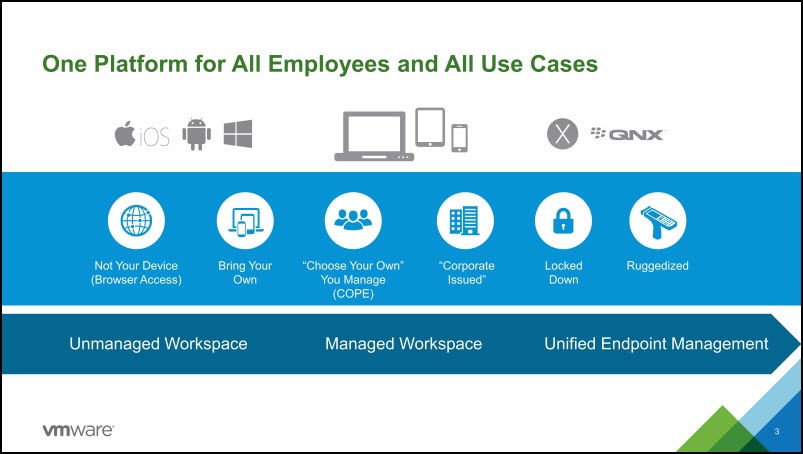
VMware Workspace ONE Essentials is an entry-level workspace manager for use by employees who don’t need high levels of security or access control. Priced at four dollars per user per month, Essentials is half the cost of the Standard Edition, which was the previous low-end offering.
Workspace ONE is a secure enterprise platform that delivers and manages any application on any device by integrating identity, application and enterprise mobility management. It’s available as a cloud service or on-premises.
The low-end edition was added to support employees like retail workers who need occasional access to applications such as human resources and intranets, but who don’t have sophisticated device management needs. “There’s no reason an employee shouldn’t have that Workspace One experience,” said Kevin Strohmeyer, senior director of product marketing for Workspace Services at VMware.
Essentials lacks mobile application management controls that enable administrators, for example, to delete an application from a managed device remotely. Users whose applications contain proprietary or sensitive information are better covered by Workspace ONE Standard Edition, which is priced at eight dollars per user per month. VMware also offers advanced and enterprise editions of the product, which add in such capabilities as direct, unattended provisioning of applications to endpoint devices.
New data loss prevention capabilities for Office 365 come in the form of a tunnel that permits administrators to control data use on supported devices. For example, users of Office 365 mobile apps have the ability to store data from Office applications in private DropBox Inc. folders, which presents security risk. Administrators can now turn off such features remotely.
VMware is also using its user conference to show a technology preview of a new version of Skype for Business for VMware Horizon that uses peer-to-peer endpoint virtual channels and offloads media processing to the endpoints. VMware Horizon is a virtual desktop delivery system that provisions user desktops over a network. The network latency that’s inherent in that architecture can cause problems like drops and delays in time-sensitive applications like voice over IP.
The preview being shown this week, which was co-developed with Microsoft Corp., creates a direct peer-to-peer endpoint virtual channel and offloads media processing to the endpoints, which improves call quality and reduces the burden on the network. The approach also provides simpler management and improved visibility, policy management and control through centralized deployment and application updates, VMware said.
Support our mission to keep content open and free by engaging with theCUBE community. Join theCUBE’s Alumni Trust Network, where technology leaders connect, share intelligence and create opportunities.
Founded by tech visionaries John Furrier and Dave Vellante, SiliconANGLE Media has built a dynamic ecosystem of industry-leading digital media brands that reach 15+ million elite tech professionals. Our new proprietary theCUBE AI Video Cloud is breaking ground in audience interaction, leveraging theCUBEai.com neural network to help technology companies make data-driven decisions and stay at the forefront of industry conversations.





