 INFRA
INFRA
INFRA
INFRA






INFRA

Veriflow Systems Inc. today is launching a network monitoring platform that takes a big data analytics approach to network monitoring, saying its technology can eliminate network outages and identify security vulnerabilities across complex networks at a scale other technologies can’t match.
Born out of research at the University of Illinois Urbana-Champaign, and backed with $10 million in series A funding put up in part by the National Science Foundation and the U.S. Department of Defense, Veriflow uses what it calls “continuous network verification algorithms” to predict all possible network-wide behavior and compare it to security and resilience policies.
Upon installation, Veriflow discovers all devices on a network using published application program interfaces and Secure Shell queries and builds a model of the current network. “Then we model an astronomical number of potential behaviors to create a model,” said Brighten Godfrey, cofounder, chief technology officer and one of a phalanx of Ph.D.s that started the company in 2013. “You define the policy over the model to see if there’s a likelihood of a disruption.”
Veriflow executives compared the process to the approach that semiconductor makers and software developers take to design. Logical models are constructed and usage scenarios run to identify defects before designs are committed to silicon or code. The process is particularly useful in identifying human oversights, such a public wireless router that is inadvertently given access to critical data, as happened in the case of the big Target Stores Inc. breach of 2013.
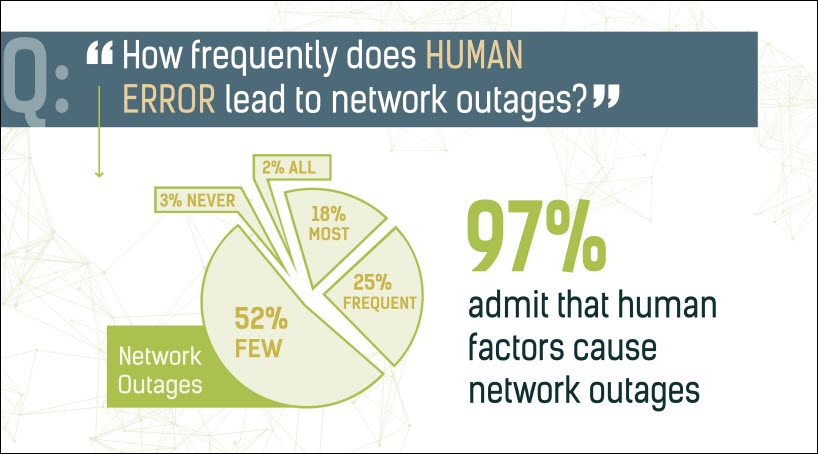
“We’re about eliminating human error,” Godfrey said. Coincident with its launch today, Veriflow is publishing a survey of 315 network professionals that found that 97 percent said human factors cause network outages (above) and two-thirds believe current monitoring solutions don’t predict most issues.
The Veriflow service can be deployed in the cloud or on-premises. Installation involves creating two virtual machines, one for data collection and another for analysis. Once the model is built, Veriflow draws from a library of best-practice policies to identify variances from policy. The service then continually monitors changes and reports new variances via an API that can be adapted to a variety of notification channels, such as text or dashboard. The company says it has a rich visualization engine, but did not provide screen images.
Veriflow executives admitted that they haven’t decided yet whether to position the product as a network monitoring or security tool, but they outlined four basic usage scenarios:
The service is available immediately. Pricing is based upon the number of devices monitored, but Veriflow wouldn’t discuss specifics, citing competitive issues.
The research the company is releasing today found that 59 percent of respondents said that growing network complexity is increasing the number of outages. Nearly 70 percent still rely on manual processes, such as configuration inspection and manual traceroutes, to diagnose problems. Eighty percent said they lack full confidence that their network is always compliant, and 83 percent said compliance reporting requires manual effort.
The survey was conducted last month by Dimensional Research, which surveyed 315 network professionals at organizations with 1,000 or more employees.
Support our mission to keep content open and free by engaging with theCUBE community. Join theCUBE’s Alumni Trust Network, where technology leaders connect, share intelligence and create opportunities.
Founded by tech visionaries John Furrier and Dave Vellante, SiliconANGLE Media has built a dynamic ecosystem of industry-leading digital media brands that reach 15+ million elite tech professionals. Our new proprietary theCUBE AI Video Cloud is breaking ground in audience interaction, leveraging theCUBEai.com neural network to help technology companies make data-driven decisions and stay at the forefront of industry conversations.





