 EMERGING TECH
EMERGING TECH
EMERGING TECH






EMERGING TECH

Pushing the envelope for embedded and Internet of Things devices, the Raspberry Pi Foundation just announced the launch of the next iteration of its “flexible form factor” personal computer-on-a-chip known as Compute Module 3.
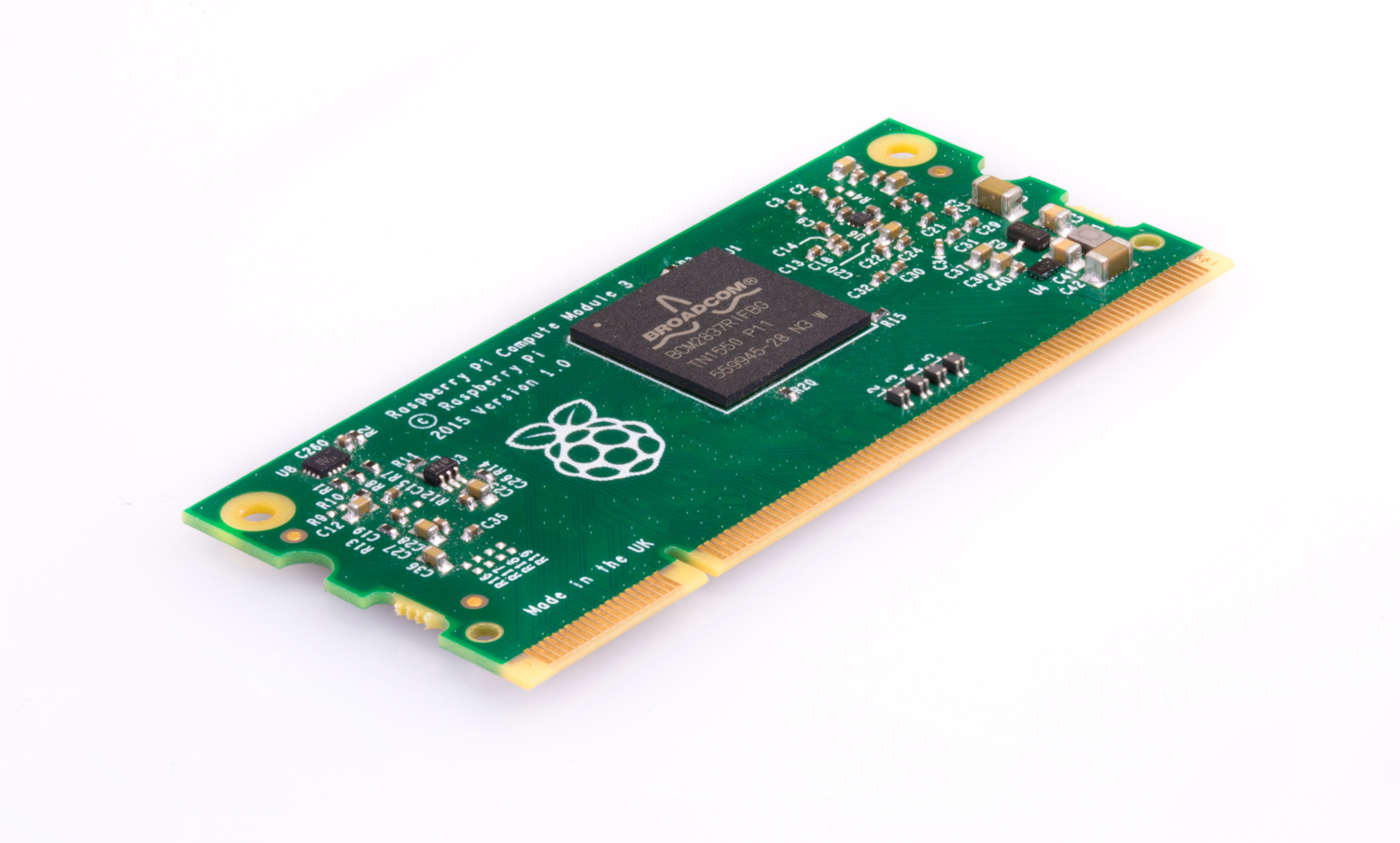
By “flexible form factor,” the foundation means extremely small: The entire Compute Module 3 (pictured) fits onto a circuit board the same size as a memory module for a laptop. Even with its tiny size, the Compute Module 3 can still run many major Internet of Things operating systems, including the Windows 10 IoT Core.
Foundation Chief Operating Officer James Adams said the new module provides twice the random-access memory and about 10 times the processing performance of the original module. The CM1 was originally released in 2014, aimed at industrial automation and IoT applications. Using the then current technology of earlier model of the Raspberry Pi, the CM1 produced a controller capable of running the IoT platforms of the time with a great deal of flexibility.
The CM3 contains the same processor as the Raspberry Pi 3, released in February 2016, and that the system can be run at 1.2HGz and support up to 1GB of RAM memory. “An IoT project can be ported from a Pi 3 onto a custom CM3-based system very easily,” Adams added.
This makes it extremely easy for an IoT hardware or software developer to use the prototype-friendly Raspberry Pi 3 platform to develop and test an application. Porting to the CM3 can wait until the final stages of the project when it’s time for application testing in industrial conditions.
According to the foundation, users of the current CM1 can upgrade directly as the two components are pin-compatible. However, the CM3 is about a millimeter taller than its predecessor and its processor can pull a lot more current, so it will create a lot more heat under heavy load.
When developing the CM3, the foundation listened to complaints from users who wanted to attach their own flash storage and built that capability into the module. The previous version came with its own fixed 4 gigabytes of embedded MultiMediaCard flash storage.
To give users options, the company is releasing two models: the standard CM3 with 4GB of flash storage and a “Lite” version that requires users to add their own memory.
The Compute Module 3 and the CM3 Lite are currently available for purchase and the price tag set at $30 and $25 respectively, excluding tax and shipping. The CM1, soon to be obsolete, is also still for sale for $25. The device can be purchased from element14 or RS Components, among other distributors. Full specifications and documentation for the CM1, CM3 and CM3 Lite are available as a datasheet from the Raspberry Pi Foundation.
Support our mission to keep content open and free by engaging with theCUBE community. Join theCUBE’s Alumni Trust Network, where technology leaders connect, share intelligence and create opportunities.
Founded by tech visionaries John Furrier and Dave Vellante, SiliconANGLE Media has built a dynamic ecosystem of industry-leading digital media brands that reach 15+ million elite tech professionals. Our new proprietary theCUBE AI Video Cloud is breaking ground in audience interaction, leveraging theCUBEai.com neural network to help technology companies make data-driven decisions and stay at the forefront of industry conversations.





