 EMERGING TECH
EMERGING TECH
EMERGING TECH






EMERGING TECH

Google Inc.’s deep learning research arm, Google Brain, has just made a whole bunch of science fiction and crime procedural shows from Star Trek to CSI come true — at least the parts where somebody points at a blurry image on a screen and commands, “Enhance.”
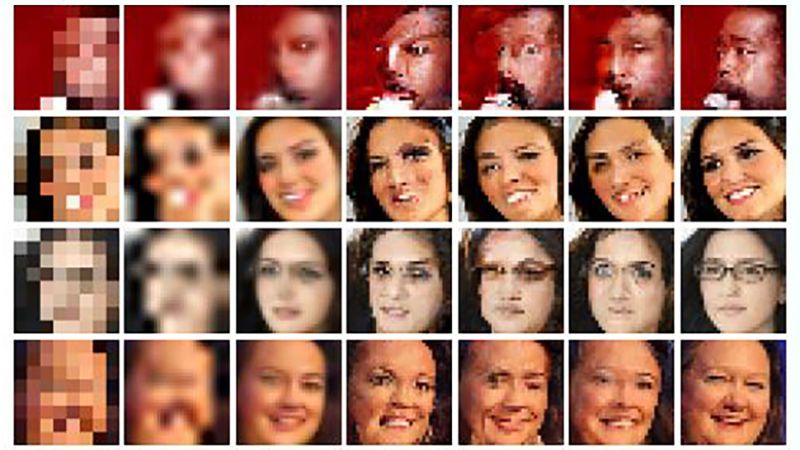
A new technology it has developed called Pixel Recursive Super Resolution can take a low-resolution photo such as a blurred image and make it clear (pictured). Of course, a low-res image is what it is, and you can’t really enhance a low-res blur to become a completely sharp face. What Google Brain has done is what is known in image processing as “hallucinations.” Armed with a database of images, the system can “hallucinate” a best guess as to what the various parts of the image should look like if it were clear.
This is not to be confused with Google’s RAISR (Rapid and Accurate Image Super-Resolution) technology, introduced last month. Although it also can sharpen an already fully manifested image using “super resolution,” it cannot create something out of an almost totally incoherent blur. Also, RAISR’s stated purpose is more to save on storage as images can be saved low-res and later recreated with super-resolution.
Anyway, with the latest system, there are two stages to making the magic happen. First is the conditioning network, in which low-res images are compared to high-res images, after which the high-res images are downsized and a best match is found.
The second part consists of tweaking the image with details, called the prior network. Using PixelCNN, the image is furnished with details based on what the software has learned such images would probably look like. If we take a face, the prior network could add pixels to the nasal cavity, giving the cavity a darker hue.
Google explains how it tested its technology on humans, asking them if they could discern what image was taken with a camera and what image was computer-generated. For images of faces, people were fooled 10 percent of the time, and for images of a bedroom, 28 percent of the time.
Support our mission to keep content open and free by engaging with theCUBE community. Join theCUBE’s Alumni Trust Network, where technology leaders connect, share intelligence and create opportunities.
Founded by tech visionaries John Furrier and Dave Vellante, SiliconANGLE Media has built a dynamic ecosystem of industry-leading digital media brands that reach 15+ million elite tech professionals. Our new proprietary theCUBE AI Video Cloud is breaking ground in audience interaction, leveraging theCUBEai.com neural network to help technology companies make data-driven decisions and stay at the forefront of industry conversations.





