 EMERGING TECH
EMERGING TECH
EMERGING TECH






EMERGING TECH

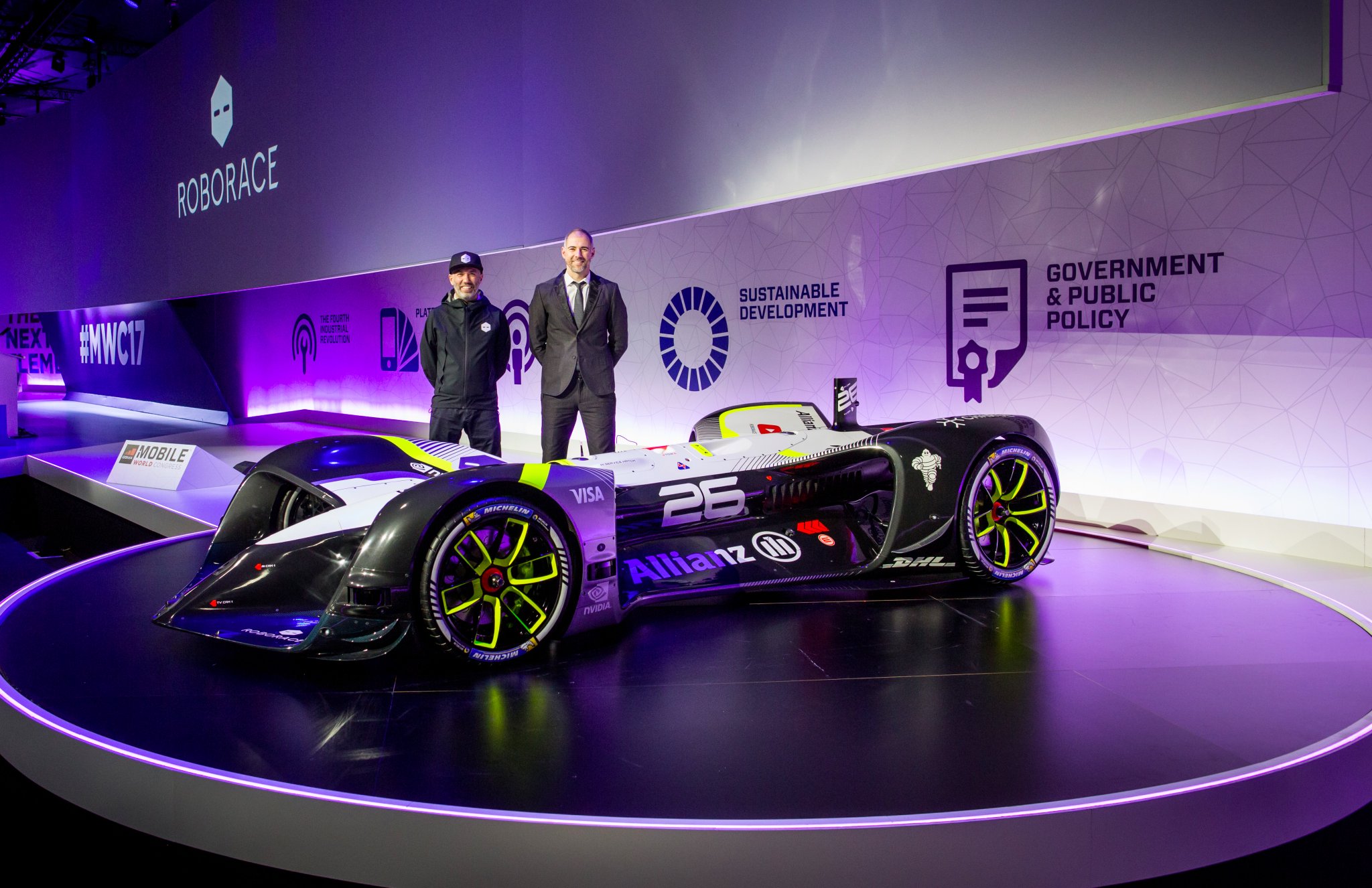
Startup Roborace Ltd. today finally unveiled its long-awaited self-driving race car.
“Robocar” is a fully electric vehicle that can reach speeds of up to 200 miles per hour without any input from a human driver. It has been roughly six months since Roborace revealed its “Devbot” prototype, a self-driving race car that runs on Nvidia Corp.’s Drive PX 2 artificial intelligence supercomputer.
Like Devbot, Robocar is also driven by the Drive PX 2, but there is one huge difference between the two cars: Robocar is not only driverless, it does not even have a driver’s seat at all.
Revealed at this week’s Mobile World Congress in Barcelona, Robocar is over 16 feet long and weighs well over 2,000 pounds. Because the vehicle has no cabin for a human driver, it stands at a little less than waist height and it is even shorter if you ignore the small aerodynamic fin at the rear of the vehicle.
Roborace wants to host autonomous car races around the world, with 10 teams competing against each other before every Formula E race. Although Roborace is looking to crown a winner, the company is not interested is seeing who can build the fastest self-driving car.
In fact, all of the company’s races will rely on its own mechanically identical vehicles, and the only difference between each team’s car will be the artificial intelligence piloting them. An Nvidia spokesperson explained last year that the company’s sole competitive advantage is software. “It’s truly a contest to build the most advanced artificial mind,” the spokesperson said.
Roborace Chief Executive Denis Sverdlov said during a press conference reported by The Verge that the races will be a “competition of intelligence” rather than who can spend the most on the best hardware.
Roborace recently held its first live race on the streets of Buenos Aires using two of its Devbot prototype vehicles, each of which were covered in decals from one of Argentina’s soccer teams. The cars raced simultaneously along a Formula E track, relying only on their sensors and their ability to communicate with one another to avoid any collisions.
One of the cars reached a top speed of 115 miles per hour, but the other vehicle crashed into a barrier and was unable to complete the race. Roborace attributed the crash to “pushing the boundaries of AI.”
Support our mission to keep content open and free by engaging with theCUBE community. Join theCUBE’s Alumni Trust Network, where technology leaders connect, share intelligence and create opportunities.
Founded by tech visionaries John Furrier and Dave Vellante, SiliconANGLE Media has built a dynamic ecosystem of industry-leading digital media brands that reach 15+ million elite tech professionals. Our new proprietary theCUBE AI Video Cloud is breaking ground in audience interaction, leveraging theCUBEai.com neural network to help technology companies make data-driven decisions and stay at the forefront of industry conversations.





