 BIG DATA
BIG DATA
BIG DATA







BIG DATA

There are two race tracks in big data — one for data and another for its analytic models’ iterative cycles. Speed is synonymous with cloud-native, but legacy companies with database business like Oracle Corp. might finish first, analysts say.
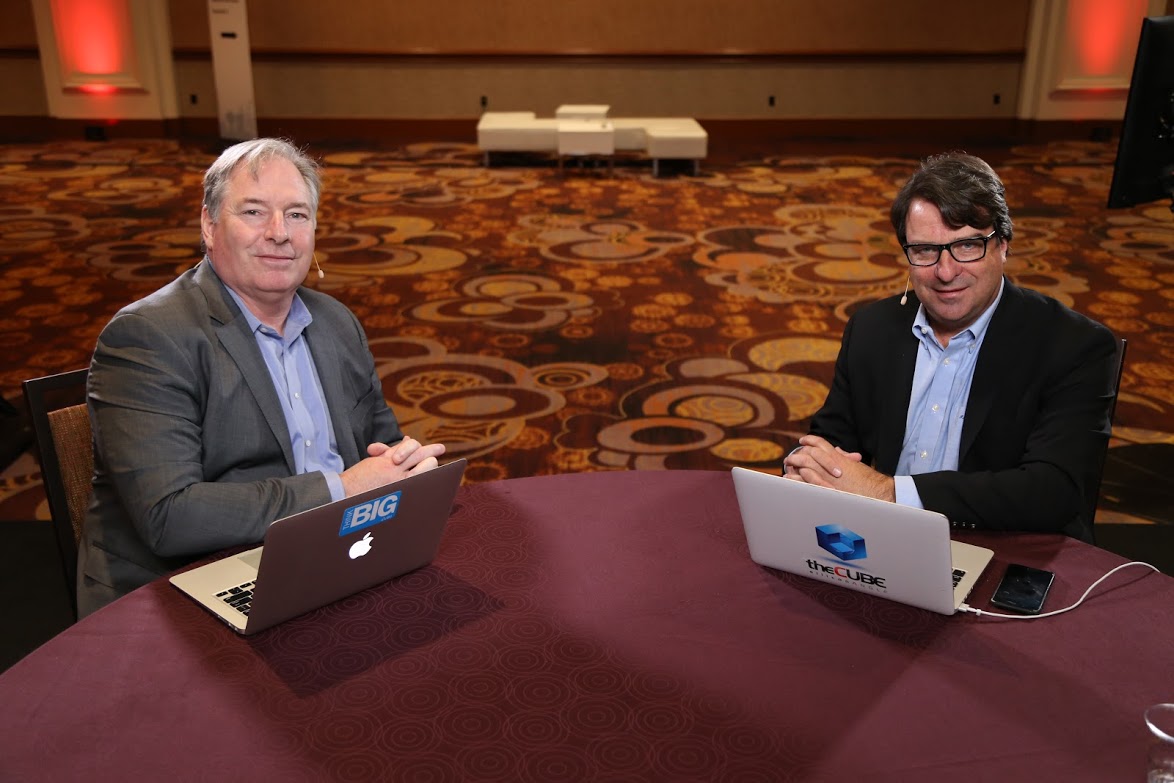
Both breeds of cloud provider have strengths, which John Furrier (@furrier) (pictured, right) and Peter Burris (@plburris) (pictured, left), co-hosts of theCUBE, SiliconANGLE Media’s mobile live streaming studio, discussed at this week’s Oracle Modern Marketing Experience in Las Vegas, Nevada. (*Disclosure below.)
“This is about not moving the data around if you don’t have to,” Furrier said, noting how Oracle stressed this point at the conference. Moving data has a physical aspect, which consumes precious time and money, Burris agreed.
Oracle’s database business, which makes it seem old school in cloud-native circles, might give it an advantage here. “Oracle is one of those companies that can talk about end-to-end,” Burris stated.
During an interview with theCUBE, Oracle’s Jack Berkowitz, vice president of products and data science for adaptive intelligence, broke this down into milliseconds. “He threw the gauntlet down. He said, ‘We are going to help our customers serve their customers within a 150 milliseconds,'” Burris said. “But you can do it if, and only if, you don’t have to move the data that much.”
The assumption is that serving data faster — to customers and within companies’ iterative cycle for refining data marketing models — will provide a competitive edge. The iterative cycle has at least as much to do with fast data technology as it does with agile marketing culture.
Oracle is well positioned in marketing data analytics, not just via its 150-millisecond promise, but also in its access to first-person versus third-person data. First-person data is generated by a business itself; third-person data might be described as the noise created by other people’s first-person data, Burris explained.
Here, Oracle’s database roots might be an inside track to first-person data. “A lot of people are big-time Oracle customers for big-time operational ex-applications that are delivering big-time revenue into the business,” Burris said.
Time will tell if younger cloud-native companies can meet or pass the 150-millisecond mark with a detour through the network. It will be an interesting match, Burris concluded.
Watch the complete video interview below, and be sure to check out more of SiliconANGLE’s and theCUBE’s independent editorial coverage of Oracle’s Modern Marketing Experience. (*Disclosure: TheCUBE is a paid media partner at Oracle’s Modern Marketing Experience. The conference sponsor, Oracle, does not have editorial oversight of content on theCUBE or SiliconANGLE.)
Support our mission to keep content open and free by engaging with theCUBE community. Join theCUBE’s Alumni Trust Network, where technology leaders connect, share intelligence and create opportunities.
Founded by tech visionaries John Furrier and Dave Vellante, SiliconANGLE Media has built a dynamic ecosystem of industry-leading digital media brands that reach 15+ million elite tech professionals. Our new proprietary theCUBE AI Video Cloud is breaking ground in audience interaction, leveraging theCUBEai.com neural network to help technology companies make data-driven decisions and stay at the forefront of industry conversations.





