 APPS
APPS
APPS
APPS







APPS

Before ready nodes, Dell EMC had customers attempting to deploy things like vSAN or other software-defined storage solutions, and they found they were running into problems. In trying to help their customers navigate those issues, Dell EMC discovered there were dependencies in that stack and in the underlying infrastructure.
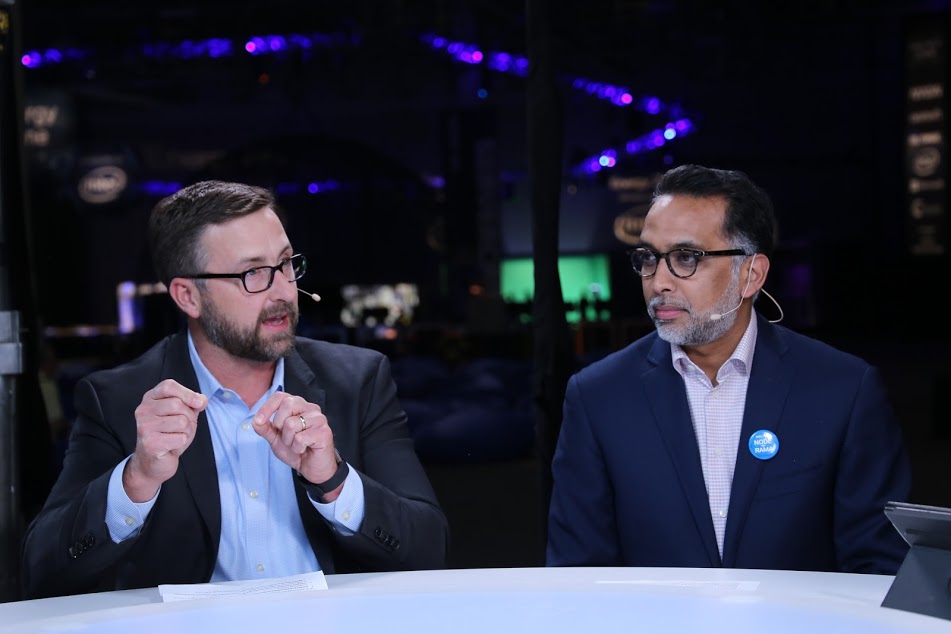
Therefore, nodes were born to solve the issue. “How can we improve that customer experience and make sure that what we deliver is going to be trusted and reliable?” asked Brian Payne (pictured, left), vice president of product management at Dell EMC’s Server Division.
During Dell EMC World in Las Vegas, Nevada, Payne and Armughan Ahmad (pictured, right), senior vice president and general manager of solutions and alliances at Dell EMC, spoke to John Furrier (@furrier) and John Walls (@JohnWalls21), co-hosts of theCUBE, SiliconANGLE Media’s mobile live streaming studio. (* Disclosure below.)
In addition to discussing the benefits of “node-a-rama,” they also talked about making life a little less (technologically, at least) complicated for customers.
In a world of increasing technological complexity, enterprises are often seeking simple solutions. Dell EMC’s ready systems do provide simplicity for customers who want to buy a full system-level solution. However, not every customer is ready to do that, for a variety of reasons. They can, let’s say, select Dell EMC PowerEdge servers to run their workload, but what do they pick after that, Payne and Ahmad explained.
An example is an enterprise that seeks to move to software-defined storage or run something like SAP HANA, a database management system. The enterprise needs something to simplify that process; that’s where ready nodes come in, Ahmad and Payne explained. It streamlines the selection of technology, where Dell EMC has performed the testing and validation, figuring out what runs well. They can then point enterprises in that direction and streamline the service offering around that.
“We’ve got a lot of nodes,” Ahmad said. He explained that Dell EMC wants to support enterprises, no matter what platform on which they choose to run.
Watch the complete video interview below, and be sure to check out more of SiliconANGLE’s and theCUBE’s independent editorial coverage of Dell EMC World 2017. (* Disclosure: TheCUBE is a paid media partner for Dell EMC World. Neither Dell nor other sponsors have editorial influence on content on theCUBE or SiliconANGLE.)
Support our mission to keep content open and free by engaging with theCUBE community. Join theCUBE’s Alumni Trust Network, where technology leaders connect, share intelligence and create opportunities.
Founded by tech visionaries John Furrier and Dave Vellante, SiliconANGLE Media has built a dynamic ecosystem of industry-leading digital media brands that reach 15+ million elite tech professionals. Our new proprietary theCUBE AI Video Cloud is breaking ground in audience interaction, leveraging theCUBEai.com neural network to help technology companies make data-driven decisions and stay at the forefront of industry conversations.





