 CLOUD
CLOUD
CLOUD
CLOUD







CLOUD

Hardware legacy Hewlett Packard Enterprise Co. is operating in interesting times, struggling to regain its losses to fresh cloud service providers.
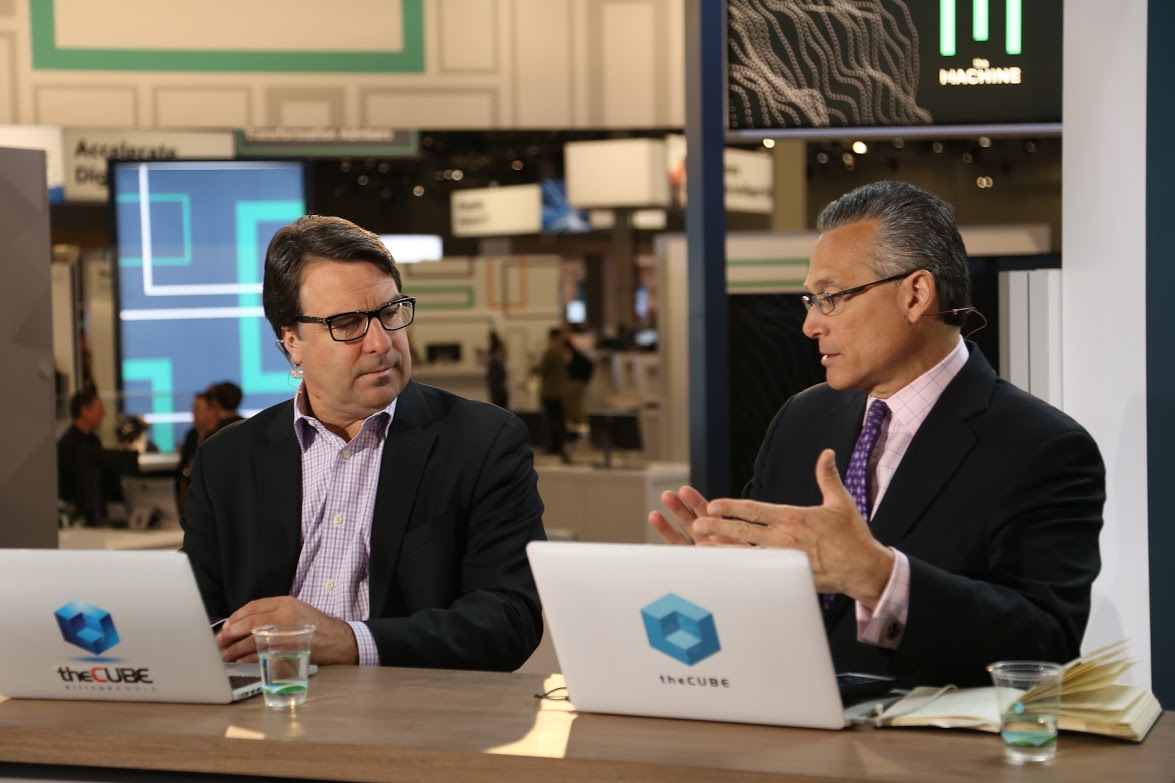
“Certainly the competition’s been slamming them; the press has not been kind to them; people think they’re irrelevant; Wall Street just slammed them,” John Furrier (@furrier) (pictured, left) told Dave Vellante (@dvellante) (pictured, right), as the co-hosts of theCUBE, SiliconANGLE Media’s mobile live streaming studio, wrapped up their coverage of HPE Discover in Las Vegas, Nevada. (* Disclosure below.)
With “hardware’s dead” practically a cliche now, it’s no wonder folks might project that onto individual hardware companies themselves, Vellante said. “The reality is, people have been telling me hardware is dying since I’ve been in the business,” he said.
The detailed truth is that hardware is consolidating rather than dying, according to Vellante. Companies are pushing the undifferentiated heavy-lifting from on-premise to public cloud and, to some extent, true private cloud.
When private cloud was first floated about three years ago, Vellante and his research team at Wikibon.com were skeptical.
“We said, ‘Oh, this is cloud-washing; really, this is just virtualization,'” he said, noting how they have warmed to the idea over time.
The market for true private cloud that mimics public cloud’s orchestration, management, agility and subscription model could grow to $250 billion in the next 10 years, Vellante said. With focus, HPE might seize and dominate that market, he argued.
Of course, HPE will have to edge out Dell EMC, another large company trying to parlay its hardware roots into a private/hybrid cloud business. Thus far, Dell EMC may appear better positioned with healthier finances and more software than HPE, Vellante stated.
However, HPE’s tear-jerking fiscal report last quarter didn’t count the CSC spin-merger profits due next month, Vellante pointed out.
“They’re going to have $12 billion in cash on their balance sheet, which will match their debt, and they’re going to start to be acquisitive. Dell EMC can’t be acquisitive right now — they’ve got to retire that [merger] debt and delever,” he concluded.
Watch the complete video interview below, and be sure to check out more of SiliconANGLE’s and theCUBE’s independent editorial coverage of HPE Discover US 2017. (* Disclosure: TheCUBE is a paid media partner for HPE Discover US 2017. Neither Hewlett Packard Enterprise Co. nor other sponsors have editorial control on theCUBE or SiliconANGLE.)
Support our mission to keep content open and free by engaging with theCUBE community. Join theCUBE’s Alumni Trust Network, where technology leaders connect, share intelligence and create opportunities.
Founded by tech visionaries John Furrier and Dave Vellante, SiliconANGLE Media has built a dynamic ecosystem of industry-leading digital media brands that reach 15+ million elite tech professionals. Our new proprietary theCUBE AI Video Cloud is breaking ground in audience interaction, leveraging theCUBEai.com neural network to help technology companies make data-driven decisions and stay at the forefront of industry conversations.





