 INFRA
INFRA
INFRA
INFRA







INFRA

Last February, Hewlett Packard Enterprise Co. plunked down $650 million in cash to buy hyperconverged server and storage systems provider SimpliVity Corp. How did SimpliVity command that price from the hardware legacy with its own portfolio of servers and storage?
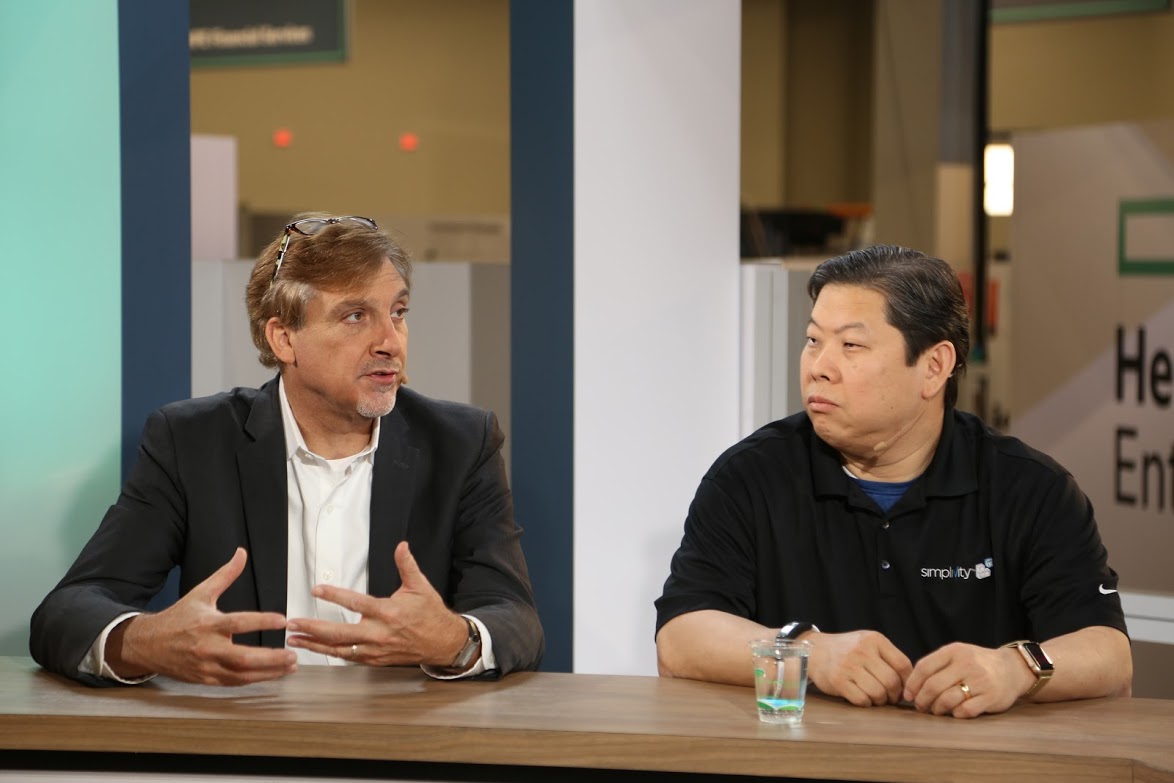
SimpliVity is not like other hyperconverged infrastructure for sale today, according to Paul Miller (pictured, left), vice president of software defined and cloud group marketing, at HPE, during an interview at HPE Discover in Las Vegas, Nevada.
SimpliVity user Danny Yeo (pictured, right), computer systems administrator at Brigham Young University, joined Miller for the discussion.
“A lot of people started at, ‘I’m going to simplify the VM management layer.’ [SimpliVity] said, ‘No, I’m going to make the most robust virtualization data-services platform in the world,” Miller told John Furrier (@furrier) and Dave Vellante (@dvellante), co-hosts of theCUBE, SiliconANGLE Media’s mobile live streaming studio. (* Disclosure below.)
Once HPE decided to progress into the hyperconverged market, it shopped around gingerly, testing every system on the market. SimpliVity beat them all, Miller stated.
SimpliVity made a host of guarantees to customers, such as 90 percent capacity savings, which HPE will make good on as its owner, Miller said.
HPE is integrating SimpliVity into new offerings that blur the line between hardware and software. One of these is its Synergy composable infrastructure platform, which Miller described: “Just think about the ability to compose and recompose highly scalable software-defined storage for enterprise applications at enterprise scale.”
Quirky use-cases such as running containers (a virtual method for running distributed applications) on bare metal give SimpliVity reach beyond enterprise IT types; developers are expressing interest in the systems too now, according to Miller.
And for what it’s worth, one customer who began using SimpliVity prior to the acquisition would like to offer his account.
“A competitor — I’ll just put it that way — came in and asked us if we would consider doing a POC [proof of concept] with their product,” Yeo recalled. A BYU engineer decided to simulate a drive failure to compare their SimpliVity system already in production against the competitor’s.
“After we pulled out the sixth drive, the other technology failed; we couldn’t recover data, basically. We’d have to send it to a data recovery center,” Yeo said.
“SimpliVity — it was business as usual,” he said, noting that the system sent plenty of alerts, but even with six drives yanked, it continued running.
Watch the complete video interview below, and be sure to check out more of SiliconANGLE’s and theCUBE’s independent editorial coverage of HPE Discover US 2017. (* Disclosure: TheCUBE is a paid media partner for HPE Discover US 2017. Neither Hewlett Packard Enterprise Co., the event sponsor, nor other sponsors have editorial influence on theCUBE or SiliconANGLE.)
Support our mission to keep content open and free by engaging with theCUBE community. Join theCUBE’s Alumni Trust Network, where technology leaders connect, share intelligence and create opportunities.
Founded by tech visionaries John Furrier and Dave Vellante, SiliconANGLE Media has built a dynamic ecosystem of industry-leading digital media brands that reach 15+ million elite tech professionals. Our new proprietary theCUBE AI Video Cloud is breaking ground in audience interaction, leveraging theCUBEai.com neural network to help technology companies make data-driven decisions and stay at the forefront of industry conversations.





