 BIG DATA
BIG DATA
BIG DATA







BIG DATA

While Silicon Valley may be the center of much of the world’s technology today, universities around the country still play a vital role in facilitating innovative research and nurturing future companies. This is especially true when it comes to agriculture, a field in which business schools and food science departments are incubating the next generation of young talent.
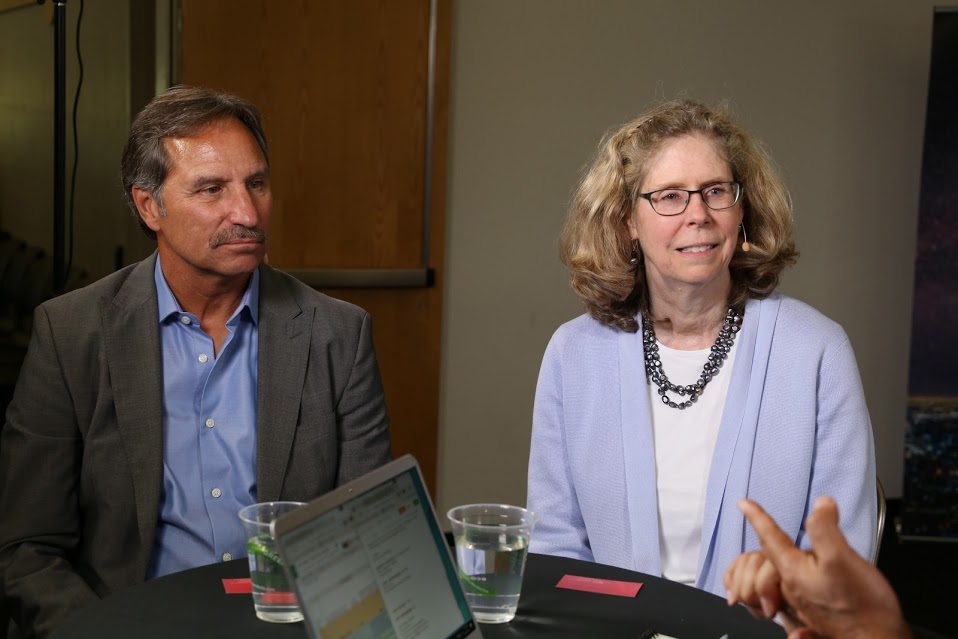
“Every university is trying to do everything they can to keep this space flowing and continue enthusiasm among young people,” said Dr. Andy Thulin (pictured, left), dean of the College of Agriculture, Food, and Environmental Sciences at Cal Poly San Luis Obispo.
Thulin provided his insight during an appearance on theCUBE, SiliconANGLE Media’s mobile livestreaming studio, and answered questions from host Jeff Frick (@JeffFrick) during this year’s FOOD IT: Fork to Farm in Mountain View, California. Thulin was joined on the set by Dr. Wendy Wintersteen (pictured, right), dean of the College of Agriculture and Life Sciences at Iowa State University, and they discussed how their respective schools foster entrepreneurship, as well as bottom-line challenges facing the farming industry. (* Disclosure below.)
Research among a group of Iowa State students led to the founding of ScoutPro Inc., a five year-old company that uses mobile technology to support agronomists, seed companies and growers in scouting crops and gathering pest and disease data, Wintersteen explained.
“We’re seeing a lot more integration between what we do and engineering, computer science and business,” she said.
At Cal Poly San Luis Obispo, students are taking entrepreneurship one step further by actually producing wine on campus. The California school owns a 14-acre commercial grade vineyard and winery where students can develop new growing methods in applied science labs. Students also participate in enterprise classes where they raise birds or grow flowers and then sell them, Thulin stated.
These kinds of programs are critical for the food and agriculture industry to meet labor and water supply challenges. Thulin cited the $2.4 billion value of California’s strawberry crop and $800 million in labor needed to harvest it. “When you think about it, that’s a lot of labor,” said Thulin, who predicted that further advances in science and innovation will benefit the farming sector.
“It’s a technology-driven industry today. It takes talent in science and technology to manage these operations,” Thulin concluded.
Watch the complete video interview below, and be sure to check out more of SiliconANGLE’s and theCUBE’s coverage of the FOOD IT: Fork to Farm event. (* Disclosure: TheCUBE is a paid media partner for FOOD IT: Fork to Farm. Neither Western Digital Corp., the event sponsor, nor other sponsors have editorial influence on theCUBE or SiliconANGLE.)
Support our mission to keep content open and free by engaging with theCUBE community. Join theCUBE’s Alumni Trust Network, where technology leaders connect, share intelligence and create opportunities.
Founded by tech visionaries John Furrier and Dave Vellante, SiliconANGLE Media has built a dynamic ecosystem of industry-leading digital media brands that reach 15+ million elite tech professionals. Our new proprietary theCUBE AI Video Cloud is breaking ground in audience interaction, leveraging theCUBEai.com neural network to help technology companies make data-driven decisions and stay at the forefront of industry conversations.





