 INFRA
INFRA
INFRA
INFRA







INFRA

Private and public clouds added to on-premises data centers are breaking the infrastructure environment into pieces. Harried customers want their data protected wherever it lands, which is why some vendors are baking protection into a whole range of products.
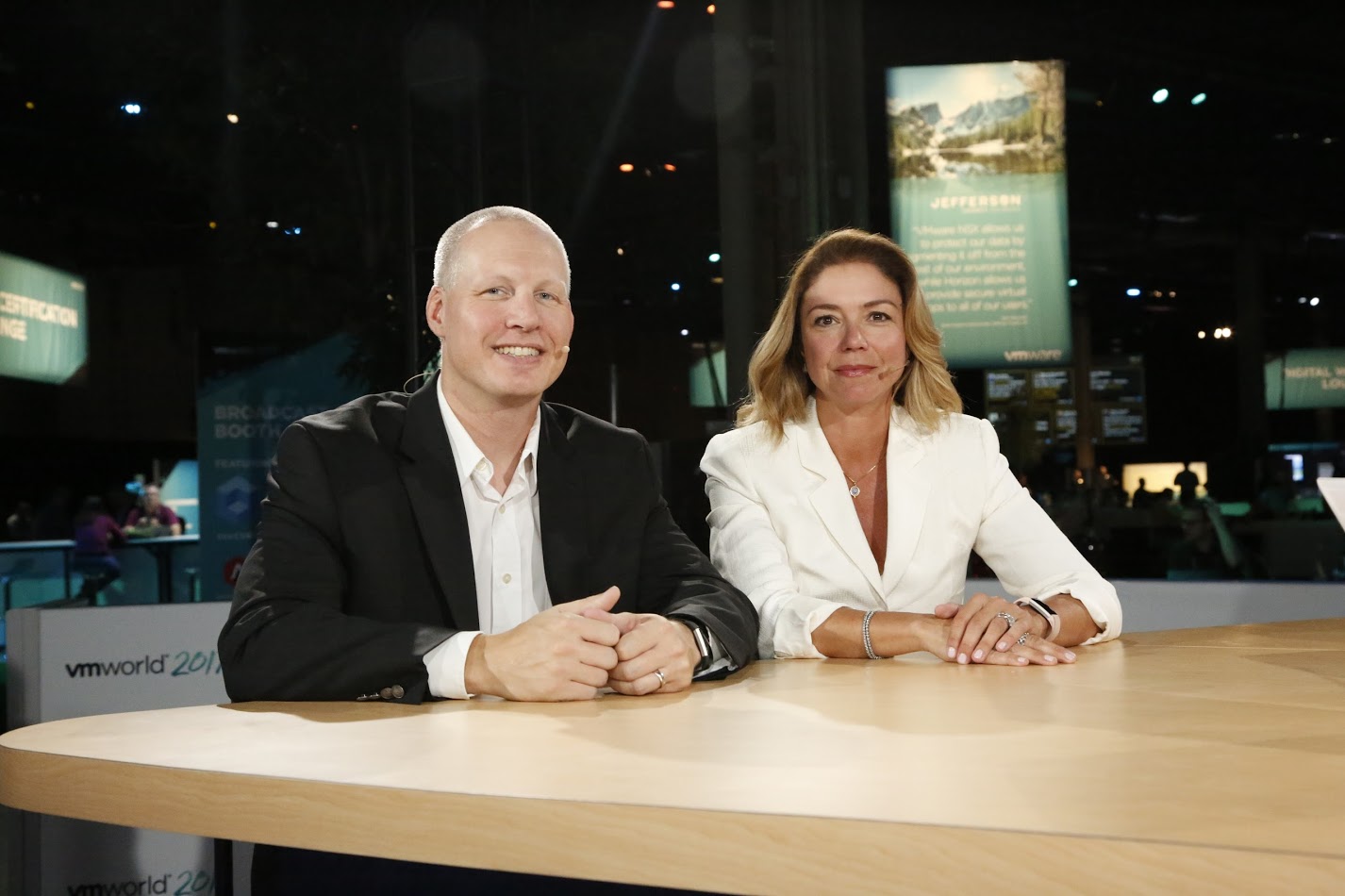
“We’re really seeing much more of a move toward a source-based data protection,” said Ruya Barrett (pictured, right), vice president of marketing, data protection, at Dell EMC.
In the past, many companies would build their data centers and then bolt on protection and backup as an afterthought, Barrett stated. “Data is moving closer and closer to where it’s being created, so you need to protect it at the source, not in the background,” she said, adding that applications that require compute at the edge are a case in point.
Barrett joined Mark Wiseley (pictured, left), chief information officer at Palmer College of Chiropractic, in a live interview at the VMworld conference in Las Vegas, Nevada, where they spoke with Lisa Martin (@LisaDaliMartin) and Dave Vellante (@dvellante), co-hosts of theCUBE, SiliconANGLE Media’s mobile livestreaming studio. (* Disclosure below.)
Dell EMC is working to build data protection directly into the stack at multiple layers, from the hardware to the application. For example, there is the recently announced Integrated Data Protection Appliance, with integrated data protection storage and software. And the company’s new Data Protection Suite for Applications enables database administrators to protect their own workloads with native user interfaces, Barrett pointed out.
Palmer College of Chiropractic recently updated its on-prem infrastructure with a Dell EMC VxBlock converged appliance. The integrated data protection was a bonus selling point, Wiseley said. “I kind of look at it as a data center in a box type thing. It solved our networking issues and our backup issues,” he said.
The cross compatibility of these data protection tools — from one environment to another — helps build a bridge from on-prem to cloud, Wisely stated. “Now we have the tools in place so we can decide when we need to move into the cloud, what data do we need to move into the cloud, and where do we need that data to be,” he said.
Watch the complete video interview below, and be sure to check out more of SiliconANGLE’s and theCUBE’s coverage of VMworld 2017. (* Disclosure: TheCUBE is a paid media partner for VMworld 2017. Neither VMware Inc. nor Dell EMC have editorial control over content on theCUBE or SiliconANGLE.)
Support our mission to keep content open and free by engaging with theCUBE community. Join theCUBE’s Alumni Trust Network, where technology leaders connect, share intelligence and create opportunities.
Founded by tech visionaries John Furrier and Dave Vellante, SiliconANGLE Media has built a dynamic ecosystem of industry-leading digital media brands that reach 15+ million elite tech professionals. Our new proprietary theCUBE AI Video Cloud is breaking ground in audience interaction, leveraging theCUBEai.com neural network to help technology companies make data-driven decisions and stay at the forefront of industry conversations.





