 CLOUD
CLOUD
CLOUD
CLOUD







CLOUD

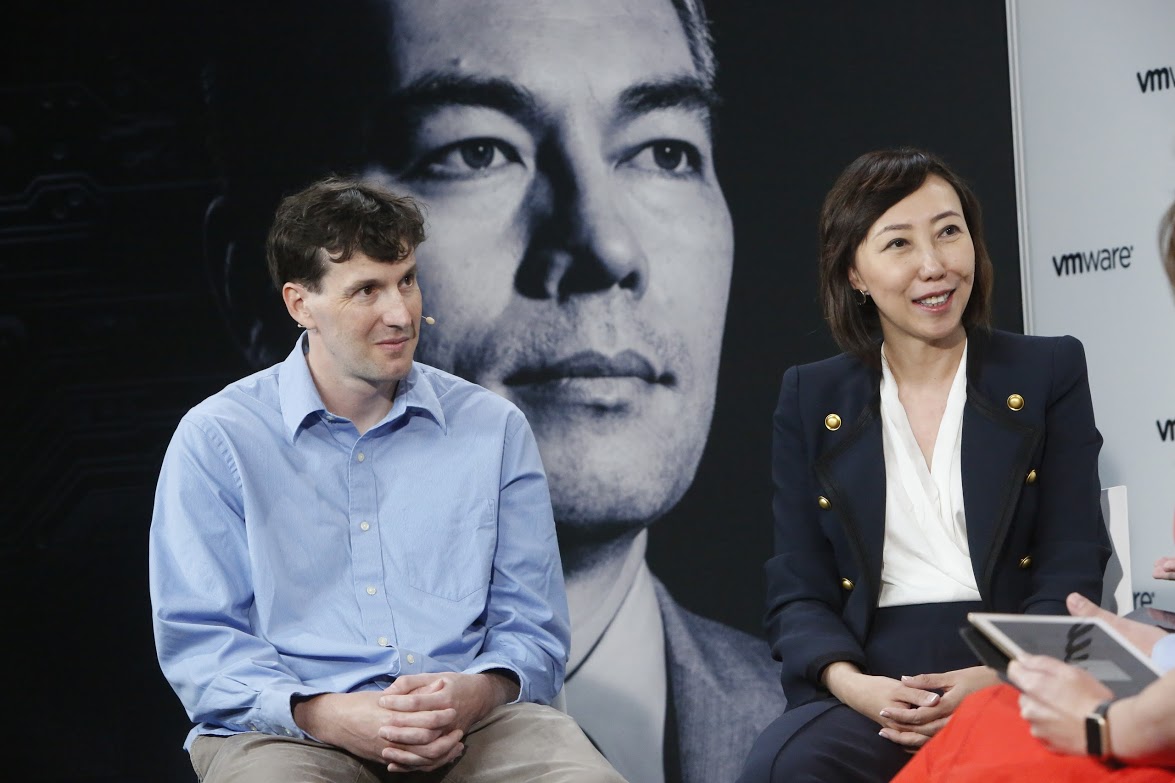
Private cloud environments are gaining new powers thanks to hyperconverged infrastructure, or HCI, and public-cloud compatibility. These infusions are making private clouds easier to manage and giving them the agility and elasticity of public cloud, according to Yanbing Li (pictured, right), senior vice president and general manager of storage and availability at VMware Inc.
“Private cloud is sexy again,” said Li, who joined Matt Amdur (pictured, left), principal engineer at VMware, during an interview with Lisa Martin (@LisaDaliMartin) and Stu Miniman (@stu), co-hosts of theCUBE, SiliconANGLE Media’s mobile livestreaming studio, at the recent VMworld conference in Las Vegas, Nevada. (* Disclosure below.)
HCI is the new architecture of choice for private clouds, according to Li. Part of its appeal is the ease with which its software-defined aspects extend to public cloud. In fact, customer requests to extend VMware’s virtualization technology to public cloud was a catalyst for VMware Cloud on Amazon Web Services Inc.
“If you had vSphere [VMware hypervisor] workloads and you wanted to bring them to the cloud, there was nothing that was compatible,” Amdur said, explaining that he helped to integrate VMware and AWS technologies into the finished product. VMware’s goal was to build a bridge for vSphere and vSAN software-defined storage to AWS’ highly scalable cloud infrastructure.
VMware Cloud on AWS is a managed service, which makes operating a private, hybrid-cloud environment simpler for customers, Amdur explained. “Customers don’t have to worry about managing the vSphere software life cycle — VMware’s now going to do that for them. And Amazon’s going to manage the physical infrastructure,” he said.
VMware has also introduced proactive support technology called Skyline Collector that automatically collects and analyzes data on customers’ infrastructure. “Customers do not want to worry about the plumbing around their infra, so we’re gathering analytics, we’re pumping them into the cloud, we’re performing intelligent analysis,” Li stated.
Skyline provides cloud analytics on how businesses are using storage and data, what applications are consuming storage, latency constraints, etc. “Being able to package that up and show it to customers in real time and help them both understand what they’re currently doing and future planning, we see a lot of value in,” Amdur concluded.
Watch the complete video interview below, and be sure to check out more of SiliconANGLE’s and theCUBE’s coverage of VMworld 2017. (* Disclosure: TheCUBE is a paid media partner for VMworld 2017. Neither VMware Inc. nor other sponsors have editorial control over content on theCUBE or SiliconANGLE.)
Support our mission to keep content open and free by engaging with theCUBE community. Join theCUBE’s Alumni Trust Network, where technology leaders connect, share intelligence and create opportunities.
Founded by tech visionaries John Furrier and Dave Vellante, SiliconANGLE Media has built a dynamic ecosystem of industry-leading digital media brands that reach 15+ million elite tech professionals. Our new proprietary theCUBE AI Video Cloud is breaking ground in audience interaction, leveraging theCUBEai.com neural network to help technology companies make data-driven decisions and stay at the forefront of industry conversations.





