







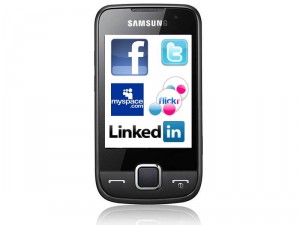
 Social media is still dominated by Facebook at the moment, and reports show us that Facebook will maintain its top position in the following period as well. Looking at the U.S., 90 percent of social media users were committed to Facebook, while in Europe the percentage is slightly lower at 85 percent. In 2010, 10 percent of page views in the U.S. were attributed to Facebook. At the beginning of 2010, the time spent online by Facebook users increased from 8 percent to 12 percent by the end of 2010.
If we take into consideration the growing number of mobile users, along with rising adoption around mobile web browsing, mainly accessed for social media sites, it becomes obvious that social media is approaching a certain level of permeated maturity, prompting mobile manufacturers to incorporate social media tools into their devices. HTC launched ChaCha, a classy Android phone that features one-touch access to Facebook, hence the ‘Facebook phone’ nickname playing off Facebook’s denial of launching its own mobile device.
Regarding the other players in the social media game, the situation is a bit hectic. Google, for example has no strategic plan for its varied, socially integrated access points, and Google Social Search and Google Buzz are still irrelevant when it comes to mobile. There is quite a bit of potential for Google to tap, however, as Google incorporates social mechanisms into certain mobile apps, namely Google Maps. Its other properties like YouTube, however, span another growing trend around mobile video.
Big data becomes a central point in mobile social media, as it becomes a matter of scaling down for mobile access and personalized use. This is another area of growing maturity, as Facebook has already determined its intentions around mobile languages like HTML5. Our mobile devices are uniquely able to socialize our personal data, in turn making it more useful on a collective scale. Analyzing that data and turning it into something useful is also an area mobile’s apt to tackle, with location being another “dimension” for socially driven big data to leverage.
Support our mission to keep content open and free by engaging with theCUBE community. Join theCUBE’s Alumni Trust Network, where technology leaders connect, share intelligence and create opportunities.
Founded by tech visionaries John Furrier and Dave Vellante, SiliconANGLE Media has built a dynamic ecosystem of industry-leading digital media brands that reach 15+ million elite tech professionals. Our new proprietary theCUBE AI Video Cloud is breaking ground in audience interaction, leveraging theCUBEai.com neural network to help technology companies make data-driven decisions and stay at the forefront of industry conversations.




