 CLOUD
CLOUD
CLOUD
CLOUD







CLOUD

Intel Corp.’s field programmable gate array acceleration stack offers tremendous potential for developers to deploy applications and workloads at maximum performance. But there can be issues when software programmers try to build applications for hardware platforms, including the time it takes. One startup company is creating new tools to make the job easier.
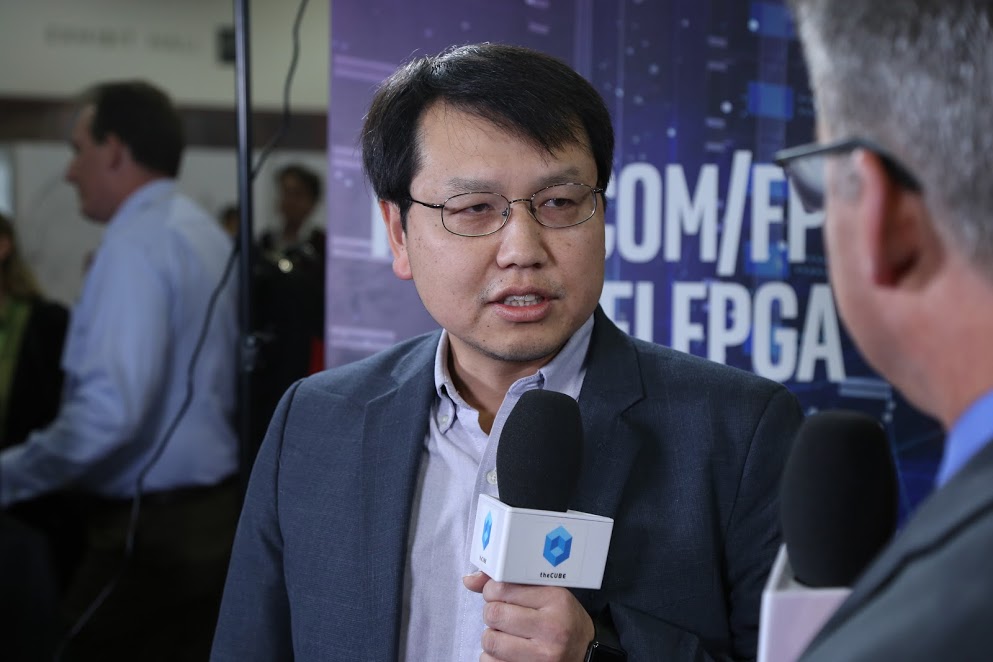
“To develop FPGA accelerators is very challenging; it’s very time-consuming and labor-intensive for [programmers]. Our goal is to liberate them,” said Jim Wu (pictured), director of consumer experience at Falcon Computing Solutions Inc.
Wu visited theCUBE, SiliconANGLE Media’s mobile livestreaming studio, and spoke with host Jeff Frick (@JeffFrick) during the Supercomputing event in Denver, Colorado. They discussed the company’s principal compiler product, its integration in the data center and cloud environments, and plans for general release. (* Disclosure below.)
Falcon Computing has developed automated compilation tools that focus on streamlining FPGA-based acceleration. Its principal product is Merlin, a compiler that provides push-button C/C++ language programming to optimize FPGA implementation and work in a fully integrated fashion with Intel’s own development tools.
“It’s a pure C/C++ flow that enables software programmers to design FPGA accelerators without any knowledge of FPGA,” Wu said. “We want to put the tool in the hands of all software programmers.”
The integration of FPGAs with Intel’s Xeon CPU has created opportunities for significant performance and power efficiency in developing applications for highly computational fields, such as machine learning, genomics and major big data projects. Falcon Computing is making the product available in a 14-day trial for use in the enterprise data center or in the cloud, and general availability is planned for the first quarter of 2018.
The company already has agreements with Amazon Web Services Inc. and Alibaba Cloud. “We are working to bring the tool to other public cloud providers as well,” Wu said. “Any space where FPGA can play well, we want to be there.”
Watch the complete video interview below, and be sure to check out more of SiliconANGLE’s and theCUBE’s coverage of the Supercomputing 2017 conference. (* Disclosure: TheCUBE is a paid media partner for the Super Computing 2017 conference. Neither Intel, the event sponsor, nor other sponsors have editorial control over content on theCUBE or SiliconANGLE.)
Support our mission to keep content open and free by engaging with theCUBE community. Join theCUBE’s Alumni Trust Network, where technology leaders connect, share intelligence and create opportunities.
Founded by tech visionaries John Furrier and Dave Vellante, SiliconANGLE Media has built a dynamic ecosystem of industry-leading digital media brands that reach 15+ million elite tech professionals. Our new proprietary theCUBE AI Video Cloud is breaking ground in audience interaction, leveraging theCUBEai.com neural network to help technology companies make data-driven decisions and stay at the forefront of industry conversations.





