 CLOUD
CLOUD
CLOUD
CLOUD







CLOUD

Balancing workloads in multicloud environments is a challenge many businesses face in adapting to cloud computing. Among struggles in strategizing data storage for maximum efficiency and optimizing security, the priority task for enterprises is in creating and deploying functional applications for customers.
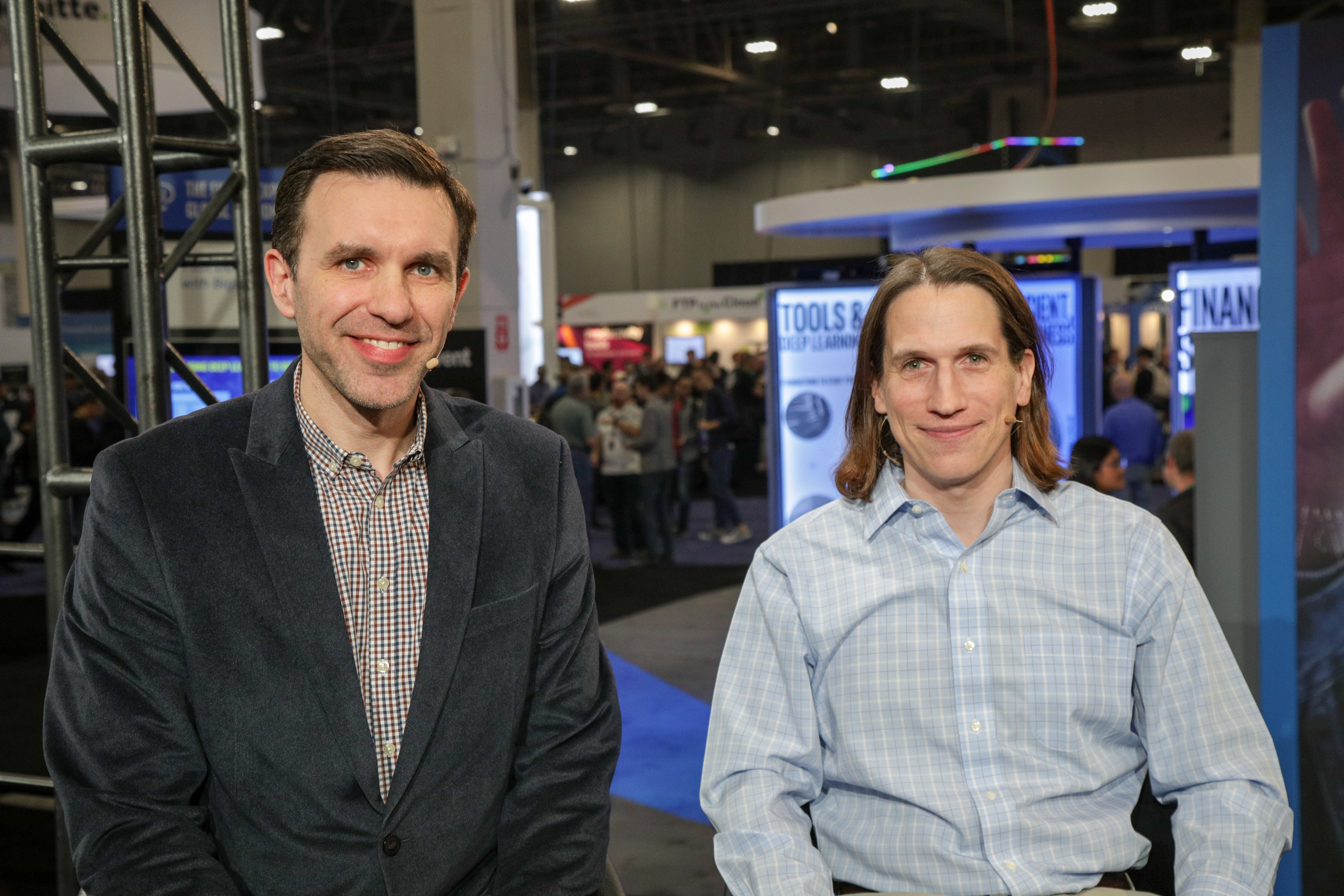
In order to support customers in workload management, container-based software deployment company Red Hat Inc. is working to automate processes enabling Amazon Web Services Inc. natively on its platform. “Developers … [can] go into the service catalog, order AWS services alongside of their applications and … deploy hybrid workloads. … You don’t have to switch between consoles; you don’t have to go outside of OpenShift. It can all be done on the platform,” said Eric Dubé (pictured, right), senior principal product manager at Red Hat. OpenShift, an open-source container application platform, is using Ansible software to enable this automation and simplify application creation and deployment.
Dubé and Tim Appnel (pictured, left), principal architect at Ansible by Red Hat, spoke with John Walls (@JohnWalls21), host of theCUBE, SiliconANGLE Media’s mobile livestreaming studio, and guest host Justin Warren (@jpwarren), chief analyst at PivotNine Pty Ltd., during the AWS re:Invent conference in Las Vegas, Nevada. They discussed the challenges enterprises face as they manage hybrid workloads and what Red Hat is doing to help them with OpenShift and Ansible. (* Disclosure below.)
Many of Red Hat’s customers run hybrid workloads, an often complicated process that the company is working to make more efficient.
“By being able to pull those services [on AWS] into the user interface, it really makes it a lot easier to deploy all the popular services … right from the platform without having to ever leave that environment,” Dubé said. The platform enables developers to immediately consume services in their environment without having to make reconfigurations, while giving the administrator options in which services they expose to their users.
Working on the Kubernetes container orchestration management system gives OpenShift flexibility and efficiency, allowing customers options in deployment environments, Dubé explained. “You don’t have to have it all in Amazon’s AWS environment or on-premise; you can run it full. … That makes it really flexible in an on-premise environment,” he said.
The OpenShift Service Catalog also provides support for customers through its standardization. “The service catalog enables self service for developers. … It really makes it a simple easy way to deploy workloads … [and] applications without a lot of work,” Dubé said.
Working with Ansible furthers efficiency efforts at Red Hat by giving customers the power to develop services with the software’s entire suite. “Ansible has always been a highly flexible tool that can adapt to different workflows [and] environments, whether that’s on-premise, legacy environments, or pure cloud or hybrid cloud,” Appnel said.
Looking ahead, Red Hat is working to address the next set of challenges its customers are facing around private clouds and transitioning from manual to automated processes. “We give them that single language that they can use through their automation. … We’re very much a Swiss Army knife and can cover a lot of ground in a lot of different environments,” Appnel concluded.
Watch the complete video interview below, and be sure to check out more of SiliconANGLE’s and theCUBE’s coverage of AWS re:Invent. (* Disclosure: Red Hat Inc. sponsored this segment of theCUBE. Neither Red Hat nor other sponsors have editorial control over content on theCUBE or SiliconANGLE.)
Support our mission to keep content open and free by engaging with theCUBE community. Join theCUBE’s Alumni Trust Network, where technology leaders connect, share intelligence and create opportunities.
Founded by tech visionaries John Furrier and Dave Vellante, SiliconANGLE Media has built a dynamic ecosystem of industry-leading digital media brands that reach 15+ million elite tech professionals. Our new proprietary theCUBE AI Video Cloud is breaking ground in audience interaction, leveraging theCUBEai.com neural network to help technology companies make data-driven decisions and stay at the forefront of industry conversations.





