 EMERGING TECH
EMERGING TECH
EMERGING TECH






EMERGING TECH

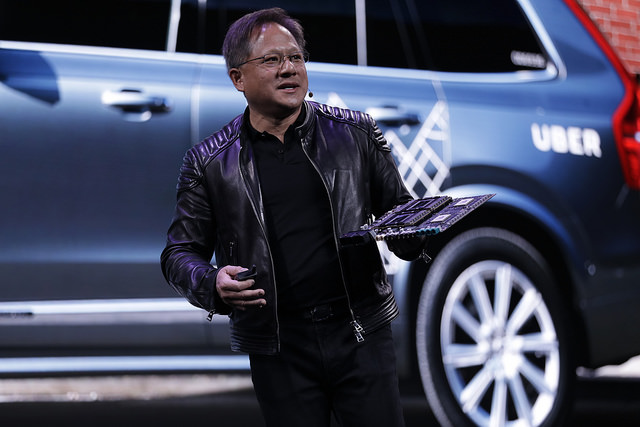
As the 2018 Consumer Electronics Show kicked off late Sunday, Nvidia Corp. Chief Executive Jensen Huang (pictured) took the stage to announce a slew of updates from the chipmaker’s autonomous vehicle group.
The main highlight was the introduction of two new software platforms designed to help automakers provide a richer user experience inside self-driving cars. Both are based on Xavier, a system-on-a-chip series that Nvidia has built to power artificial intelligence software. The processor can be found in the Pegasus computing module for autonomous vehicles that the company introduced in October.
Drive AR, the first of the new software platforms, lets developers harness a car’s Xavier chip to visualize the data generated by its sensors for passengers. They can also augment the output with external information. A mapping provider, for instance, could overlay the names of key locations and road condition details over the video feed from a vehicle’s front-facing cameras.
Drive IX, the other addition, is designed to power even more ambitious use cases. Nvidia said the software enables carmakers to create virtual assistants capable of tapping the same sensory data as Drive AR. Such Alexalike services should also be useful for music streaming and other in-vehicle entertainment, an opportunity that rival chip maker Intel Corp. is eyeing as well.
Nvidia unveiled the new software alongside a slew of major partnerships. The first and arguably most notable involves Uber Technologies Inc., which in November ordered 24,000 sport utility vehicles that will form the backbone of a new autonomous shuttle fleet.
All those vehicles will need chips to power their navigational systems. Nvidia didn’t specify if Uber will deploy Xavier processors in the SUVs, or any other technical details about the partnership for that matter. But it did divulge that ride-hailing providers is using its technology not only in robotaxis but also autonomous freight trucks.
In conjunction, Nvidia announced a collaboration with Volkswagen that will see the Nvidia XI platform used for adding AI features to several upcoming vehicle models. CNET reported that one of the items on the roadmap is a computer vision system that can recognize car owners when they approach and automatically unlock the door.
Finally, Nvidia unveiled a couple more strategically focused partnerships aimed at making its technology more appealing to the auto industry at large. The company will separately work with China’s Baidu Inc. and Aurora Innovation Inc., a self-driving car startup based out San Francisco, to develop new autonomous-driving products based on its chips.
Support our mission to keep content open and free by engaging with theCUBE community. Join theCUBE’s Alumni Trust Network, where technology leaders connect, share intelligence and create opportunities.
Founded by tech visionaries John Furrier and Dave Vellante, SiliconANGLE Media has built a dynamic ecosystem of industry-leading digital media brands that reach 15+ million elite tech professionals. Our new proprietary theCUBE AI Video Cloud is breaking ground in audience interaction, leveraging theCUBEai.com neural network to help technology companies make data-driven decisions and stay at the forefront of industry conversations.





