 EMERGING TECH
EMERGING TECH
EMERGING TECH






EMERGING TECH

Access to virtual reality is set to transform e-commerce in retail and marketing, according to a new report from Allied Business Intelligence Inc., resulting in a $1.8 billion market for these industries by 2022.
According to the report, a number of retail situated businesses are exploring VR as a way to help sell products by using the technology to essentially provide a “test drive.” To see this in a literal way, users need look no further than automotive companies such as virtual test drives and interior views for cars.
For example, General Motors Co. began rolling out VR to a portion of its Cadillac stores in 2016 that would allow visitors to don a headset and experience the interior of a luxury car. Here is a Cadillac 2016 CT6 interior 360-view available now on YouTube using a VR headset for 3-D or the mouse to look around. German automobile manufacturer Audi AG released 360-video apps for the Audi A4 with apps for Android and iOS.
The concept of virtual tourism has also given rise to the possibility of holding car and roadster shows that anyone from any part of the world can visit without leaving their own living rooms.
Goodguys Rod and Custom Association released a VR roadshow in collaboration with VisitTriValley in what was dubbed the world’s first virtual reality auto show in June 2016.
Furniture and home improvement products have also seen a bit of the virtual reality treatment. This is in part because VR provides a way for people to get a sense of scale and dimension for furniture, mix and match parts, customize products and visualize the product before making a final purchase.
“E-commerce and digital marketing enable consumers to buy products conveniently online and offer consumers the opportunity to rate, review, and share the information of products and services,” said Khin Sandi Lynn, industry analyst at ABI Research.
Retailers have deployed both in-store experiences and apps for mobile use so that customers can access virtual catalogs in different ways. Swedish furniture company Ikea and North American home improvement company Lowe’s are both examples of companies that have deployed VR experiences to sell products. Ikea is also experimenting heavily with augmented reality, VR’s layered reality-blending sibling, for furniture sales with Ikea Place.
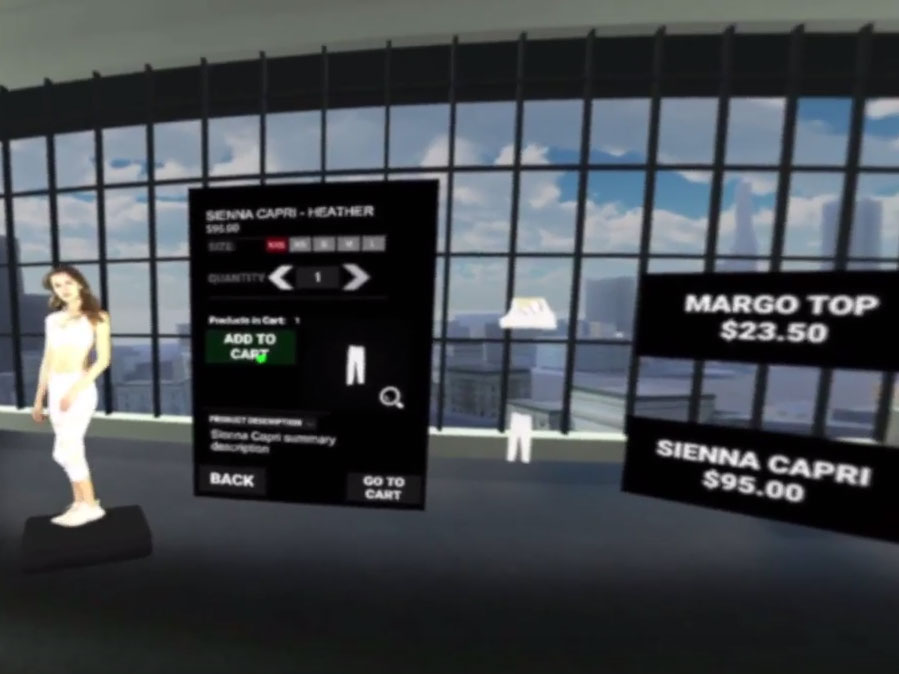
E-commerce is not being left behind by VR developer firms as retail, automotive and home improvement push forward. London-based payment processing company Worldpay released a demo VR app that allows users to “swipe” credit cards in VR while viewing products in order to simulate the buying experience virtually. Following that, Payscout Inc. announced a VR commerce application (pictured) that allows easy, frictionless payments in VR through a user interface that “pops up” out of purchasable virtual items from shirts and cars to couches to give developers the opportunity to allow VR-using customers to buy products.
In the Chinese market, e-commerce giant Alibaba Group Holding Ltd. released its own Buy+ mobile VR platform, also in 2016, to provide better product visualization. The company integrates its Alipay payment network directly into the Buy+ VR experience so customers can easily make purchases while browsing.
“There is high consumer interest to use VR for making purchase decisions while shopping online or in-store,” said Lynn. “The availability of low-cost VR headsets is another driver of consumer VR use cases for purchasing products.”
Prices for VR headsets are coming down. The Oculus Rift is now $399, down from $599 originally, and the HTC Vive is now $499, down from $799. But what will really drive this market is the upcoming stable of standalone VR headsets from various makers, such as the Oculus Go, with an expected price tag of $199, or the Vive Focus, which is expected to be in a similar price range.
Support our mission to keep content open and free by engaging with theCUBE community. Join theCUBE’s Alumni Trust Network, where technology leaders connect, share intelligence and create opportunities.
Founded by tech visionaries John Furrier and Dave Vellante, SiliconANGLE Media has built a dynamic ecosystem of industry-leading digital media brands that reach 15+ million elite tech professionals. Our new proprietary theCUBE AI Video Cloud is breaking ground in audience interaction, leveraging theCUBEai.com neural network to help technology companies make data-driven decisions and stay at the forefront of industry conversations.





