 EMERGING TECH
EMERGING TECH
EMERGING TECH







EMERGING TECH

Can humans be transported around a city as efficiently as data is moved around a computing network? One pioneering startup thinks so, engineering an intelligent bus line that works similarly to packet switching on the internet.
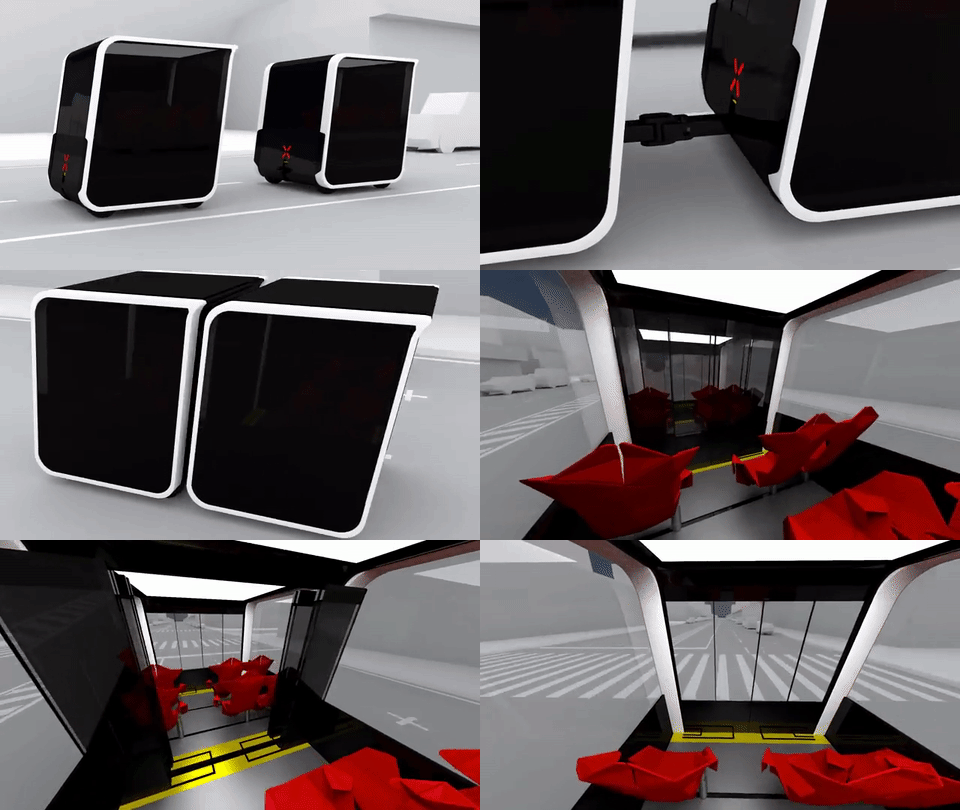
“We divided the bus in sections, so you have six modules that coupled together are the same length and capacity of a standard city bus,” explained Emmanuele Spera, founder and chief executive officer of NEXT Future Transportation Inc.
Spera spoke with Jeff Frick (@JeffFrick), host of theCUBE, SiliconANGLE Media’s video news desk, during the recent Autotech Council conference in Milpitas, California. The two discussed the economic case for efficiencies in public transportation and the importance of artificial intelligence for self-driving vehicles. (* Disclosure below.)
While the world seems enamored with self-driving cars and drone deliveries, Spera thinks more can be done with autonomous technology to solve existing issues with cities’ underutilized resources, namely buses.
“The reality is, are we taking care of the gridlocks that are affecting our city? Are we moving around enough people? Are we solving the problem of congestion? I’ll say no,” said Spera. “Because it doesn’t matter if we have an [electric vehicle], an autonomous driving vehicle, an SUV or a car, you still have congestion. You still need to have a large number of cars to move around people.”
NEXT Future’s bus pods (pictured) can already conjoin autonomously, and the company is currently working to automate the pod driver as well. Launched in 2015, the system is now fully automated in closed environments, according to Spera. NEXT Future is already working with cities to showcase its technology, citing the Dubai government as a client.
“The technology to create that, if you look at those parts, seems very far away,” he said. “But we are able to create this now using off-the-shelf components.”
Artificial intelligence is one such component that’s crucial to NEXT Future’s ultimate success, because it will help coordinate the entire system seamlessly, from the passenger to the pod. The company’s modular approach to public transportation lends to more flexible route options, minimizing the need for a passenger to hop from a bus to a taxi or a bike. Instead, pods can self-organize around passengers’ stated destinations, enabling a user to remain within the bus pod system.
The goal is for passengers to interact with the pods via a smartphone app or touchscreens installed directly into the pods, directing passengers to take Pod 1 northbound, then head east on Pod 2, for example.
Aiding NEXT Future’s AI solution is Western Digital’s Data Makes Possible program, a collective of thought leaders and community voices pontificating the challenges and opportunities of a data-driven world.
“AI is the only way we can overcome such problems,” Spera said. “Obviously, we need to take control of the basics, of the beginning of this journey. Clearly, the AI will be amazing when the system is fully working and you can predict information, you can connect with the passenger … predict behavior and predict needs on the passenger side.”
AI will also be used to predict the non-human components of the futuristic bus line, to predict how the system is flowing, how pods are using lanes, where traffic is backed up and the optimal locations for pod coupling, Spera explained.
Here’s the complete video interview, and there’s more of SiliconANGLE’s and theCUBE’s coverage of the Autotech Council Autonomous Vehicles event. (* Disclosure: TheCUBE was a paid media partner for the Autotech Council Autonomous Vehicles event. Neither Western Digital Corp., the event sponsor, nor other sponsors have editorial control over content on theCUBE or SiliconANGLE.)
Support our mission to keep content open and free by engaging with theCUBE community. Join theCUBE’s Alumni Trust Network, where technology leaders connect, share intelligence and create opportunities.
Founded by tech visionaries John Furrier and Dave Vellante, SiliconANGLE Media has built a dynamic ecosystem of industry-leading digital media brands that reach 15+ million elite tech professionals. Our new proprietary theCUBE AI Video Cloud is breaking ground in audience interaction, leveraging theCUBEai.com neural network to help technology companies make data-driven decisions and stay at the forefront of industry conversations.





