 APPS
APPS
APPS
APPS






APPS

Facebook Inc. has announced new privacy protections on the platform to comply with the European General Data Protection Regulation or GDPR that will go into effect next month.
However, it’s aiming to exempt 1.5 billion users in Africa, Asia, Australia and Latin America, or about 70 percent of its user base worldwide, from its new terms of service created to comply with the new European Union regulation, according to a Reuters report. Facebook did say it plans to apply the same European privacy protections to users in the U.S. and Canada, but they wouldn’t be governed by the same, often more stringent EU laws.
The regulation is designed to ensure consumers fully understand what information is collected about them and to make sure companies are transparent regarding what happens to that information. It requires companies to give consumers easy access to such data, the control over it and the ability to delete it.
Although the privacy changes Facebook is making are in compliance with these European regulations, the updates will affect users globally. In the coming weeks when people log on to Facebook, they will be asked to agree to the new terms of service that Facebook claimed are written in a very straightforward way.
In a blog post Tuesday, Facebook listed some of the things people will be asked. They will include the option to review information about targeted advertising and whether they want Facebook to use data from partners to show them ads.
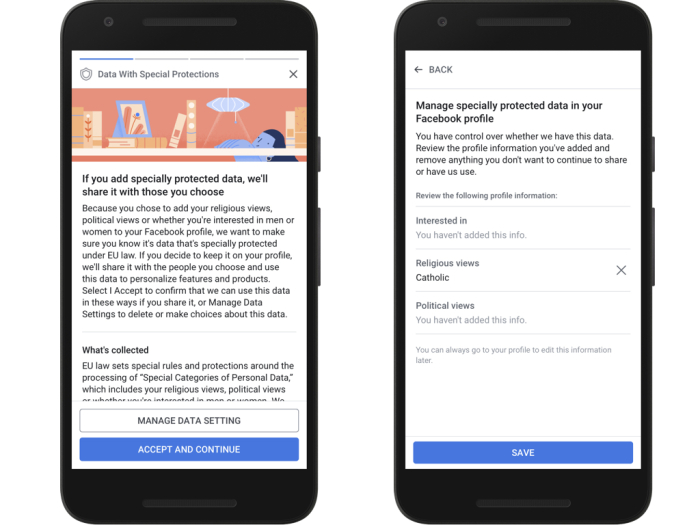
Consumers will also have the option to review political, religious and relationship information on their profile and then consider whether they want to continue sharing that information. The company said people in Europe and Canada will also be given the option to turn on face recognition technology that’s used to tag them in pictures and also prevent someone from using their photos as their own. This feature has not been available for some years in those regions.
The move has not come without criticism, though, with some people stating that the updates are designed to trick consumers into sharing their data more widely.
Facebook “GDPR” settings are mostly set-up to get you to “accept and continue” and go through messy options if you try anything else—and you don’t get full data collection control. This UX design is obviously intentional, driven by the business model. Simple as that. https://t.co/i7qFXPuUPA
— zeynep tufekci (@zeynep) April 18, 2018
Indeed, it’s not so simple to just say no. If users don’t click on “continue” when asked about privacy options they’ll be taken to another page that presents more information, which according to The Guardian, will push them “into accepting the change.” Only on a third page can they opt out.
“Everything about the page is designed to manipulate you into doing the thing they want,” a former Facebook operations manager said in an interview with Wired. “The goal of the design exercise is to get you to accept, and not go into your settings and turn things off.”
Likewise, a slew of other media said the changes for all intents and purposes are to encourage people to share as much information as possible. As TechCrunch pointed out, perhaps these changes are simply inadequate and down the line Facebook might be facing lawsuits if they’re not seen as fully compliant with GDPR rules.
Support our mission to keep content open and free by engaging with theCUBE community. Join theCUBE’s Alumni Trust Network, where technology leaders connect, share intelligence and create opportunities.
Founded by tech visionaries John Furrier and Dave Vellante, SiliconANGLE Media has built a dynamic ecosystem of industry-leading digital media brands that reach 15+ million elite tech professionals. Our new proprietary theCUBE AI Video Cloud is breaking ground in audience interaction, leveraging theCUBEai.com neural network to help technology companies make data-driven decisions and stay at the forefront of industry conversations.





