







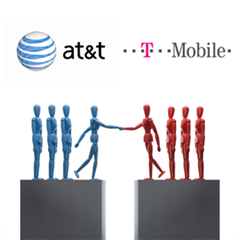
 The wireless broadband industry is currently reeling at the thought of AT&T merging with their long-time competitor T-Mobile USA. Such a move would certainly change the very landscape of the U.S. wireless market and will rock the foundations of broadband and consumer expectations from the three remaining biggest players. Analysts have already begun to identify potential problems with regulatory measures governing such mergers and why the deal might end up finding itself blocked by the Federal Communications Commission.
Of course, there’s no reason why the grim attention of the FCC couldn’t be surmountable, as long as AT&T is willing to play ball. According to an article in Forbes, playing ball may involve a lot of concessions. Especially noting how the U.S. has a well known fear of major players getting together and toppling markets as monopolies. Although, with two other companies holding the top spots (and still others waiting in the wings) that may be less of a problem here.
Analysts are already expressing doubts. In a research note released Sunday after the deal was announced, Credit Suisse analyst Jonathan Chaplin called it “phenomenal…if it happens.” The reason for his skepticism? The regulatory risk for such a deal is “enormous,” wrote Chaplin.
[…]
The antitrust implications spur Chaplin to write that he has “never seen a deal with more regulatory risk be attempted in the U.S.” He adds that since AT&T is unlikely to “attempt a deal that they knew would fail,” the company may be willing to make “massive divestitures and concessions” to win approval for the transaction. The deal needs the blessing of the U.S. Department of Justice and the Federal Communications Commission (FCC).
Fears are running high that the merger would create an industry leader that will use their leverage to set market trends and lock customers in. As they are wont to do, consumer groups and other industry watchdogs have already come out to denounce the deal such as Public Knowledge who characterized the deal as “unthinkable.”
“The combination of the second-largest wireless carrier, AT&T, with the fourth-largest, T-Mobile is, as former FCC Chairman Reed Hundt once said, ‘unthinkable,’” quotes Gigi B. Sohn, president and co-founder of Public Knowledge. “We urge policymakers to think similarly today. The wireless market, now dominated by four big companies, would have only three at the top. We know the results of arrangements like this – higher prices, fewer choices, less innovation.”
Media Access Project, a public interest law firm, posted their agreement about how the AT&T and T-Mobile merger would “…further increase costs and decrease choices for the public.” But they went on to speak about the National Broadband Plan:
“Needless to say, it also presages a major confrontation at the Justice Department and the FCC. The FCC’s National Broadband Plan, issued last year, warned about the absence of sufficient competition in the wireless market. The possibility that three players would control nearly three-quarters of that market will surely trigger intense scrutiny by the agencies.”
AT&T has defended itself by attempting to tie the deal back into what it could do for the same broadband plan, giving itself a pat on the back for possibly offering millions of dollars for updating national infrastructure. With such a size advantage, AT&T would have a huge incentive to bolster their capabilities and the tasks its network could handle—however, regulators still have to weigh that against the changes it will force into the market.
The deal looks good from a “big players do big things for the market” angle—which AT&T intends to play up for all its worth—but it looks a little bit rocky when it comes to an industry that’s dominated mostly by big players and a merger will make AT&T the biggest fish in a still shrinking pond. To make their deal look safer to regulators, they’ll have to show that they can expand the overall consumer base and deliver changes to market and infrastructure that will boost the experience for all broadband rather than just their networks.
Support our mission to keep content open and free by engaging with theCUBE community. Join theCUBE’s Alumni Trust Network, where technology leaders connect, share intelligence and create opportunities.
Founded by tech visionaries John Furrier and Dave Vellante, SiliconANGLE Media has built a dynamic ecosystem of industry-leading digital media brands that reach 15+ million elite tech professionals. Our new proprietary theCUBE AI Video Cloud is breaking ground in audience interaction, leveraging theCUBEai.com neural network to help technology companies make data-driven decisions and stay at the forefront of industry conversations.




